The Wouldbegoods: Being the Further Adventures of the Treasure Seekers — When Helping Goes Wrong
KeepReap Editorial
A secret society, a rulebook and a record of noble deeds ought to make being good straightforward. The Bastable children discover how much these arrangements leave out. In The Wouldbegoods, helping someone can involve a raft, a river lock or a roadside drinks stall, while the intended beneficiary has scarcely been consulted. Nesbit builds the comedy around a practical question: who gets to decide what help is needed?
The society and the summer
| Author | E. Nesbit |
|---|---|
| First published | 1901 |
| Genre | Comic country adventure; Bastable family sequel |
| Length | Approximately 78,000 words; 14 chapters |
| English level | B2–C1 |
A holiday with rules for being good
The Bastables have moved beyond the financial troubles that drove The Story of the Treasure Seekers, but comfort has not made them consistently considerate. A garden game involving their uncle's stuffed animals creates enough disorder to send them into the country. At the Moat House, a rambling old home with a moat, farm buildings and places to explore, they share their holiday with Daisy and her brother Denny. Albert's uncle writes nearby and provides adult supervision.
Dora, Alice and Daisy propose a secret society devoted to goodness. The children agree rules, assign offices and undertake to perform kind actions. Their record of achievements gives each enterprise the prospect of recognition, even when Oswald would rather avoid talking solemnly about virtue.
The surrounding countryside supplies opportunities their planning cannot contain. A stranded barge seems to need water; thirsty travellers seem to need refreshments; borrowed historical stories suggest expeditions of their own. Each chapter follows a scheme into contact with working people, animals or unfamiliar local customs. The adventures remain realistic, although the children constantly give them the language of romance and heroic exploration. Expect a comic holiday whose central experiment concerns behaviour, rather than a continuous search for buried treasure.
The trouble with a recorded good deed
The society turns goodness into something that can be organised, measured and entered in a book. That makes its project appealing and questionable at once. A child can start looking for an impressive deed instead of noticing an ordinary need. When the group imagines grateful barge workers celebrating their benefactors, the pleasure of being thanked is already competing with the wish to help.
Consent and knowledge repeatedly complicate generosity. Operating the river machinery requires more than recognising that a barge cannot float. The children understand the immediate difficulty while missing the wider system surrounding it. Nesbit makes that gap visible through physical consequences, so consideration becomes a matter of learning how another person's world works.
Denny also tests the relationship between goodness and courage. At first the Bastables interpret his shyness as weakness. His behaviour under pressure challenges their confident classification. The society's stated commitment to helping people they dislike creates a particularly awkward test: its members must reconsider their own judgement, not simply perform an impressive action for someone else.
Six Bastables, two visitors and competing consciences
Oswald wants energetic action and a leading role. He accepts the society's presidency while remaining suspicious of excessive moral talk. His explanations often reveal mixed motives before he recognises them himself. Dora brings responsibility to the group, and Alice readily responds to someone else's distress, though enthusiasm can outrun practical knowledge.
Dicky shares Oswald's resistance to solemnity and often presses a scheme towards action. Noel's poetry gives adventures a second life in words; H. O., the youngest, introduces literal questions and unpredictable suggestions, including the circus. The siblings continually negotiate whose interpretation will prevail.
Daisy supplies the original idea for the society. Her brother Denny arrives as a timid visitor but becomes a more complicated companion than the Bastables expect. Albert's uncle balances his writing with their demands and understands their imaginative language. Local people, including the farmer and Mrs Simpkins, have concerns the children's council cannot settle on their behalf.
Watch the plan meet the person it is meant to help
Try following a plan through three stages: the need the children identify, the heroic result they imagine, and the actual person's response. The waterworks adventure makes these stages especially clear. A grounded barge looks like a simple problem with a generous solution; machinery and consequences turn that solution into a much larger undertaking. The reader can see how an apparently sound first observation supports an unsound conclusion.
The society's record adds a second comic mechanism. Rules and official positions imitate adult organisations, yet their application depends on children arguing about what counts as noble. The book examines moral language through that friction without requiring a separate lecture after every mishap.
Denny's changing place in the group gives these experiments emotional weight. Being brave and being noisy are not identical, as the tower episode demonstrates. Nesbit lets the children misread another child and then confront evidence they cannot comfortably fit into their earlier account. Their mistakes have both a comic shape and a personal cost.
A summer of councils, excursions and explanations
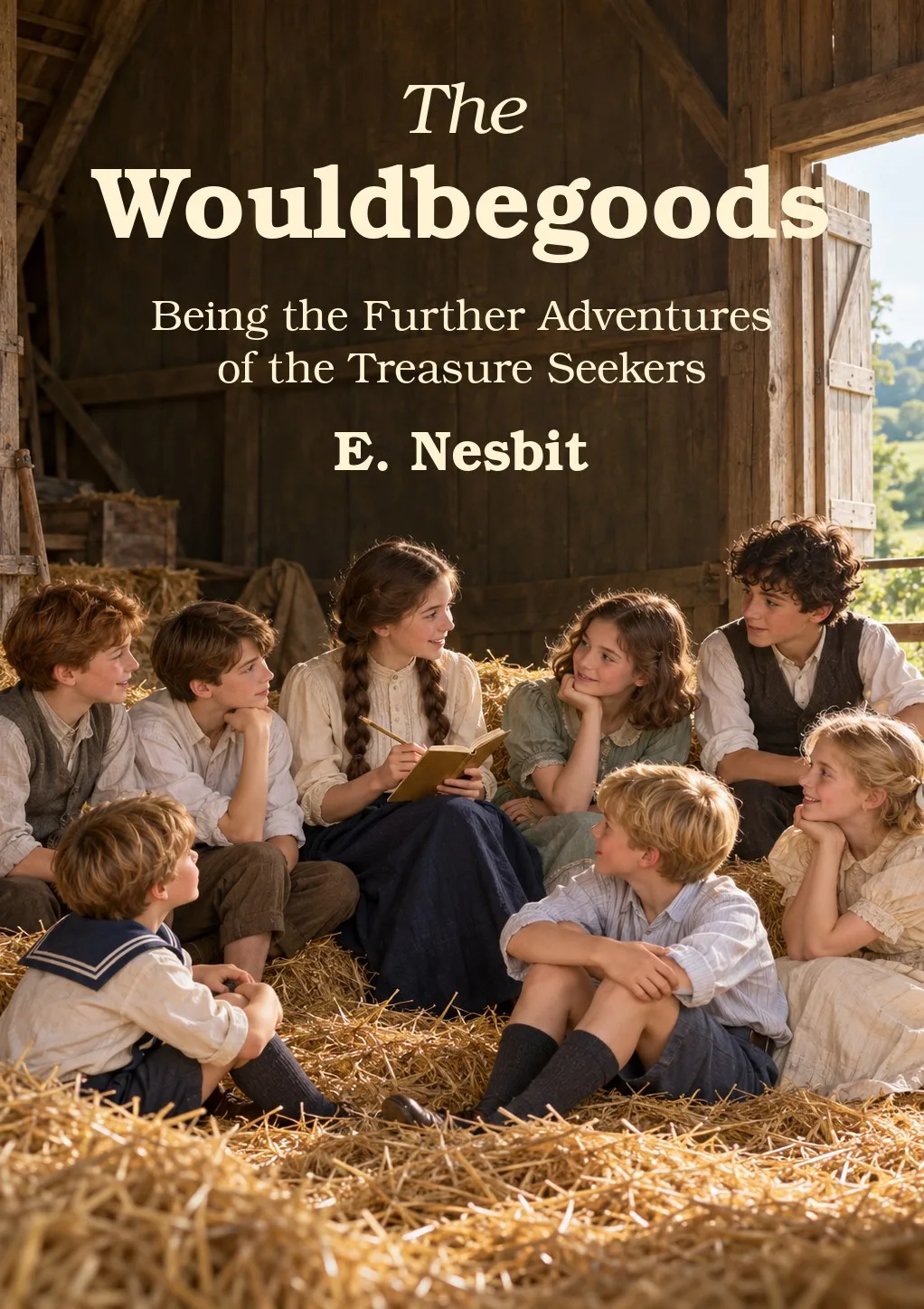
The Moat House feels like a starting point for repeated departures. Children hold councils in the straw loft, gather equipment and head towards a stream, tower or road. Their preparations can be as absorbing as the advertised adventure because a debate about supplies exposes conflicting versions of the game.
Oswald interrupts the action to justify himself, discuss expressions or complain about how stories are written. Those interruptions create a talkative intimacy, but they also delay information and make the reader assess his explanations. A grand description can collapse into a blunt observation within the same passage.
The fourteen chapters allow regular stopping points, though each is substantial. The tower produces real anxiety; an animal episode may become upsetting; quieter encounters interrupt the broad farce. The holiday consequently feels unruly rather than uniformly cheerful, with sympathy arriving through embarrassment as often as through a successful plan.
Reading the gap between noble language and practical action
The society's vocabulary offers a useful clue to the reading challenge. Words about nobleness, benevolence and unselfishness make the enterprise sound official; ordinary verbs then describe children carrying buckets, borrowing objects and arguing. Understanding both registers helps a reader hear the comedy. B2–C1 is an editorial estimate for the original: B2 readers may follow the adventures with selective support, while C1 readers are better placed to catch their implications independently.
Everyday dialogue is often short and direct, but the narrator inserts qualifications, parenthetical explanations and mock heroic phrases into longer sentences. Locate the main action before untangling an aside. Oswald's movement between speaking as himself and discussing Oswald by name also requires attention.
Vocabulary includes period school slang, farm equipment, river transport and historical money. Rural speakers sometimes use dialect grammar or spellings. Their meaning may become clearer when a line is sounded out than when each unfamiliar form is searched separately.
Cultural context contributes another layer: the children borrow from adventure literature, pilgrimage history and classical myth. The dragon's teeth episode needs a little awareness of soldiers springing from planted teeth to make the imagined danger intelligible. At approximately 78,000 words, the book also asks for stamina. Illustrations support visible action; they cannot explain every literary reference, prejudice or ironic defence.
Choose it for experiments rather than exemplary behaviour
Readers interested in the difference between intending kindness and practising it have a strong reason to spend this holiday with the Bastables. The society's plans invite discussion because the children can be affectionate, resourceful and inconsiderate within one enterprise. Shared reading works particularly well when participants disagree about the waterworks plan before hearing its consequences.
The earlier family adventure, The Story of the Treasure Seekers, supplies background, although this sequel explains enough to orient a newcomer. Readers seeking Nesbit's magical creatures should expect games and misunderstandings here. Sensitive readers may want support around animal harm and the period's stereotypes. For independent learners, substantial chapters and recurring slang make this a better choice after experience with shorter original English stories.
Questions about the Wouldbegoods
What does the title The Wouldbegoods mean?
The Wouldbegoods names children who would like to be good but have not mastered how to do it. They turn that ambition into a secret society with rules and a record of deeds. The awkward invented word suits their awkward experiment: announcing a good intention does not guarantee a useful result.
Should I read The Story of the Treasure Seekers first?
Reading The Story of the Treasure Seekers first gives you the Bastables' earlier circumstances and relationships, but it is not essential. The Wouldbegoods introduces the siblings and explains the move into a more comfortable household before the country holiday. Start with the earlier book if you want to follow the family's changing situation in order.
Is there real magic in The Wouldbegoods?
The Wouldbegoods is a realistic adventure rather than a supernatural fantasy. Its children interpret ordinary events through stories, including the myth of dragon's teeth producing soldiers. Their belief can make an episode feel extraordinary, but readers should distinguish what the children imagine from what the narrative allows them to understand.