At the Back of the North Wind: Diamond Between Dreams and London Streets
KeepReap Editorial
A hole in a hayloft wall becomes a window belonging to somebody else. When Diamond blocks the draught, a voice objects: North Wind wants her opening back. Their argument begins in the language of household inconveniences, then expands into questions about goodness, suffering and trust. At the Back of the North Wind keeps that movement throughout: extraordinary journeys return a small boy to the ordinary people who need him.
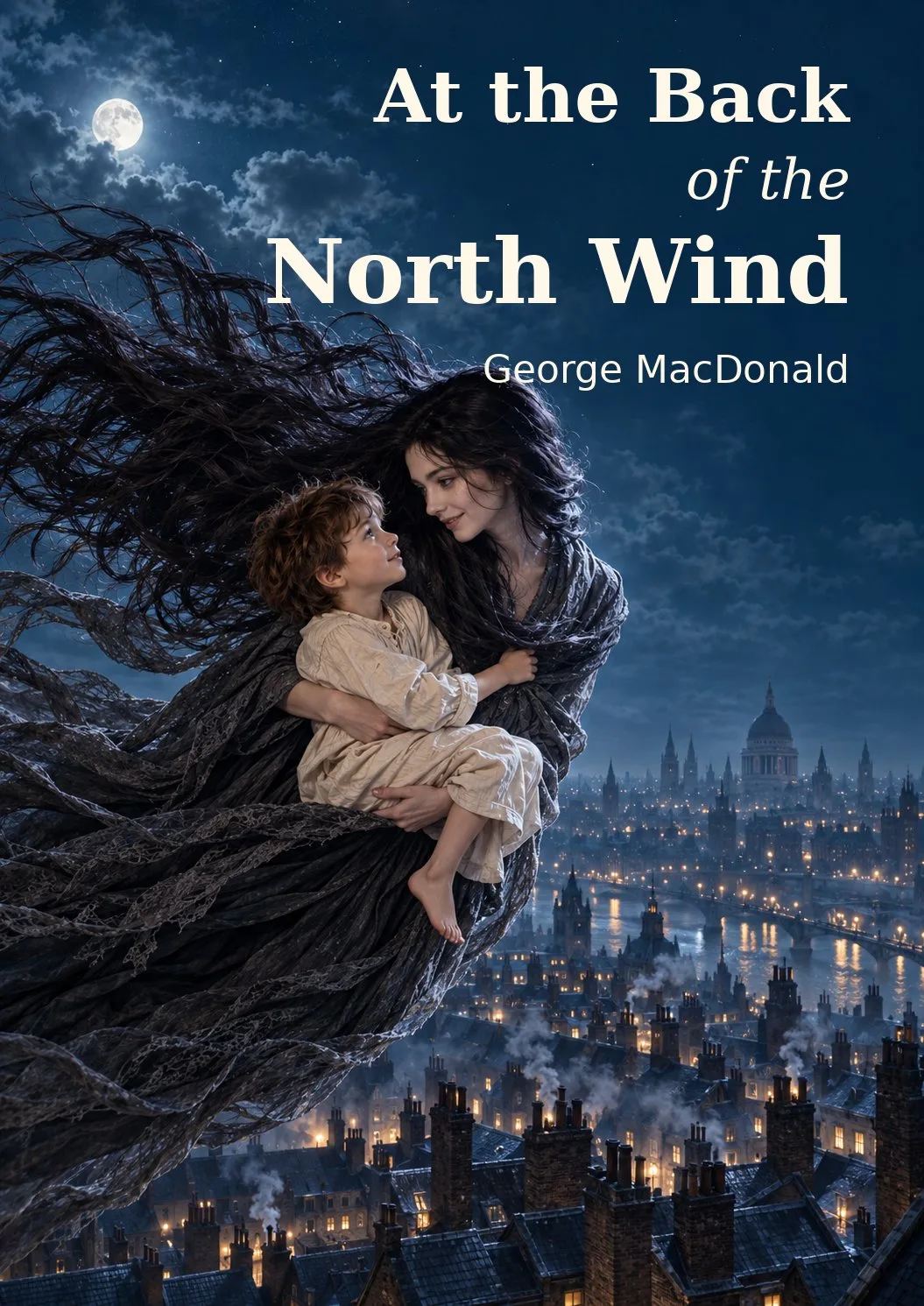
| Author | George MacDonald |
|---|---|
| First Published | 1871 |
| Genre | Literary fairy tale and Victorian social fantasy |
| Length | 38 chapters; approximately 88,000 words |
| English Level | B2–C1 |
A bedroom window opens onto a larger world
Diamond sleeps in a hayloft above a coach-house, close enough to hear the horses below. His father works as a coachman, and the boy shares his name with a favourite horse. One night the wind speaks through a hole beside his bed. The visitor becomes a beautiful woman with streaming black hair, able to change her size and carry him above the city. She calls herself North Wind.
Their travels lead through stormy skies, a cathedral and a mysterious country associated with the book's title. Diamond trusts his companion, but he also asks awkward questions. If she is good, why does her work sometimes appear destructive? Her answers do not turn every frightening event into something he can easily understand.
The story also follows the family's changing circumstances. In London's mews, Diamond helps with babies, horses and his father's work. He meets Nanny, a crossing-sweeper whose difficulties cannot be solved by a flight through the clouds. Dreams, songs and practical acts of care run alongside one another. Rather than building toward a conventional battle against a villain, the book asks what Diamond's encounters make possible in his daily life.
Two Diamonds, a wind and a crossing-sweeper
Diamond approaches adults with questions that sound simple until somebody tries to answer them. His confidence is unusual, but his usefulness is concrete: he comforts babies, tends horses and notices distress other people would prefer to ignore. The narrative repeatedly lets others misunderstand that combination.
North Wind is affectionate and powerful, with duties beyond Diamond's understanding. She carries him and talks with him, yet she cannot be reduced to a helpful fairy granting wishes. Her changing appearance makes trust an issue rather than an automatic response to beauty.
Joseph and Martha, Diamond's parents, bring wages, illness and household anxiety into the story. Old Diamond, the horse, connects the boy's imaginative world to the family's livelihood. Nanny introduces the harsher conditions of street work; her friendship with Diamond includes irritation as well as gratitude. Mr Raymond, a sympathetic gentleman and storyteller, links practical assistance with stories and poetry. These relationships give the fantasy consequences outside Diamond's private adventures.
Follow the journey back into the mews
Watch what happens after a marvellous journey. The boy who has travelled with North Wind returns to rooms where somebody must prepare breakfast or quiet a baby. MacDonald gives those actions narrative weight. When Diamond visits the distressed household of a drunken cabman, he begins by comforting the child instead of delivering a speech to the adults. The scene makes his response visible before anybody explains its moral meaning.
Another mechanism is the clash between literal questions and uncertain answers. In the opening conversation, Diamond treats a hole, a window and ownership as matters that should make sense. North Wind's replies change the scale of the argument without removing his right to ask. Later exchanges continue that pattern.
Together, these devices create a useful reading test: does an extraordinary experience sharpen attention to ordinary needs? The book returns to that question through horse care, family work and friendship. Its fantasy gains force from these repeated returns, rather than from a steadily increasing display of magical powers.
Kindness without an easy explanation of suffering
Care is measured through action. Diamond's songs are not simply decorative expressions of happiness; they accompany nursing babies and easing tension in cramped rooms. The family must still eat and pay rent, so his cheerfulness exists beside material difficulty. The novel's religious outlook gives kindness and trust significance, but its working households keep those ideas attached to bodies, food and labour.
Suffering raises a harder problem. North Wind's tenderness toward Diamond does not prevent her from carrying out frightening tasks. His questions about other people's pain resist the assumption that his own safety settles everything. Readers encounter a tension between trust in a larger purpose and the limits of what either conversation or imagination can explain.
Appearance and judgement form another recurring contrast. Diamond's unconventional speech encourages people to underestimate him; a grand-looking or confident adult is not necessarily more perceptive. North Wind also asks him to think beyond a pleasing face. Across these interactions, goodness cannot be identified merely by beauty, social standing or the ability to sound sensible. The narrative asks readers to observe conduct before accepting labels.
Songs interrupt the road through London
The opening feels intimate: hay, boards, bedclothes and a voice close to the child's ear. Flights above London expand the space abruptly. Later, the scale contracts again into cab journeys and household conversations. That alternation creates a rhythm of wonder followed by practical attention.
The narrator addresses readers, interrupts explanations and sometimes admits the difficulty of reporting Diamond's experiences. Those interventions make the account conversational, but they can slow a reader expecting uninterrupted action. Poems and songs change the pace further. The long tale of Little Daylight introduces another fairy-tale world inside the novel, while hospital listeners remind us where it is being told.
Gentleness does not mean constant comfort. Illness, drinking, poverty and frightening weather stand beside humour and affectionate conversations. The reading experience is consequently quieter, stranger and more emotionally unsettled than a sequence of safe magical excursions.
Plain questions, strange answers and Victorian words
Much of Diamond's dialogue uses familiar words and short questions. The problem is often what an answer implies. In the opening chapter, the disagreement over a window turns on perspective and ownership, not rare vocabulary. A learner may understand each sentence while needing another reading to follow the argument.
Historical words add a separate burden. Mews, cab, coach-house and Hansom describe a transport system and living arrangements that modern readers may not picture immediately. Informal speech also includes nonstandard grammar and spellings. These are features of character voices, not patterns to imitate in formal English.
Narrative sentences can contain qualifications, interruptions and comparisons that delay the main point. Poetry presents another kind of difficulty: rhyme, unusual compounds and sound patterns sometimes matter more than a straightforward literal paraphrase. Listening to a song aloud can reveal its movement without resolving every image.
The cultural context includes Christian language, ideas about providence and references to older literature. Those passages demand more than following a cab ride. Across approximately 88,000 words and 38 chapters, stamina also matters. B2–C1 is an editorial estimate for the original English: a B2 reader can follow many scenes with dictionary and contextual support, while independent interpretation of the poetry and philosophical dialogue often calls for C1 skills. Reading one exchange carefully is more useful than translating every word mechanically.
For readers willing to linger over uncertainty
Readers drawn to thoughtful fairy tales may appreciate a child who argues with his supernatural companion instead of simply receiving instructions. Diamond's questions about North Wind's work, and his attention to Nanny's circumstances, give adults substantial material alongside the flights and songs. Younger readers may benefit from sharing the book with someone willing to discuss its harder moments.
English learners who already manage extended fiction can approach it chapter by chapter, keeping a small glossary of transport and household terms. Reading the songs aloud and separating what physically happens from what characters believe helps. Readers seeking fast adventure, a neatly explained magic system or consistently cheerful bedtime material may find the book less suitable. Its hospital scenes and family anxieties deserve room for conversation.
Questions before you start
Is North Wind simply a friendly fairy?
North Wind is a friendly companion to Diamond, but her role in At the Back of the North Wind is more difficult than granting wishes or protecting him from every problem. Her work can appear frightening, and Diamond questions the suffering connected with it. Reading her as an uncomplicated helper misses the tension that drives their conversations.
Why does At the Back of the North Wind spend so much time on cabmen and horses?
The cabmen and horses connect Diamond's imaginative experiences to his family's livelihood. In At the Back of the North Wind, feeding a horse, earning fares and caring for a baby show what kindness requires in practice. London's mews are central to the book's argument, rather than background that readers should hurry past to reach another magical journey.
Can a B1 learner read the original At the Back of the North Wind?
A B1 learner may understand selected conversations with support, but the original At the Back of the North Wind is a demanding independent choice. Its length, historical vocabulary, poems and indirect philosophical answers raise the difficulty beyond the shortness of Diamond's questions. The B2–C1 editorial estimate describes sustained reading of the original, not an adapted retelling.
References
Project Gutenberg — Complete text of At the Back of the North Wind
Macmillan — At the Back of the North Wind
The Works of George MacDonald — At the Back of the North Wind