The Water-Babies: A Chimney Sweep, Talking Salmon and Victorian Science
KeepReap Editorial
Tom’s first problem is soot, hunger and a master who beats him. His next world contains talking salmon, argumentative insects and fairies whose names sound like rules of conduct. The Water-Babies moves between those worlds with surprising speed. Charles Kingsley’s fairy tale asks how a neglected child might change, while continually interrupting his adventures to challenge the adults who claim to know how everything works.
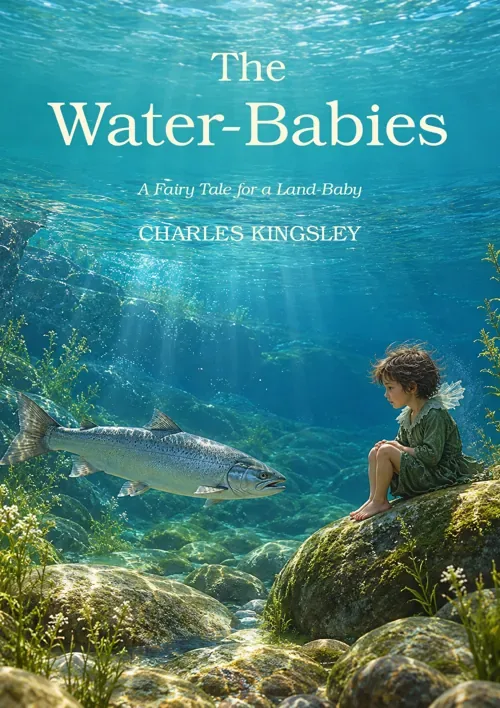
| Author | Charles Kingsley |
|---|---|
| First published | 1863 |
| Genre | Victorian literary fairy tale and social satire |
| Length | Approximately 69,000 words; eight chapters and a concluding Moral |
| English level | B2–C1 |
From a bedroom looking-glass to the river
Tom works as a chimney sweep in northern England under the brutal Mr. Grimes. At Harthover Place, he accidentally enters a young girl’s bedroom and sees his own dirty appearance in a looking-glass. The encounter exposes a difference he has scarcely considered: other children live with cleanliness, comfort and care. A frightened escape carries him away from the house and toward a secluded valley.
The river opens another existence. Tom becomes a tiny water-baby with gills, able to move among creatures whose ordinary lives now look extraordinary. He explores pools, meets insects and fish, and travels toward the sea. Yet a new body does not automatically give him kindness or good judgement. His curiosity can become meddling, and his desire for pleasure can become selfishness.
Ellie, the girl from Harthover, remains important to his story, while supernatural women connect his experiences to questions of responsibility. The narrative expands from a child’s escape into a wandering education. Expect animal conversations, songs and imagined places, alongside frequent detours in which the narrator argues with teachers, scholars and readers themselves.
A chase becomes a wandering argument
The opening has the pressure of a chase: narrow chimneys, a forbidden bedroom and a frightened child moving through unfamiliar country. Once Tom enters the river, forward movement loosens into observation and conversation. A creature’s habits can hold up the journey for several pages.
That wandering pace becomes especially noticeable when the narrator turns away from Tom to ridicule education or learned debate. Songs and poetic epigraphs create further pauses. Eight chapters therefore do not mean eight short episodes; each can contain several distinct movements.
The tone alternates between tenderness and aggressive joking. The moonlit river offers stillness, while the discussion of impossible scientific proofs deliberately piles up absurdity. Readers who accept these shifts may enjoy the mixture. Readers seeking continuous adventure may find the narrator’s argumentative presence harder to tolerate than the fantasy itself.
The people and creatures who educate Tom
Tom begins with very little power. His bad habits come from a life in which adults neglect or exploit him, but the underwater chapters still ask him to take responsibility for his behaviour. Watching him discover both freedom and limits supplies the story’s movement.
Mr. Grimes represents the adult authority Tom initially knows: work enforced through hunger, fear and blows. Ellie offers a different relationship. Her cleanliness first makes Tom conscious of his condition; her later companionship gives his education a more personal dimension.
Mrs. Bedonebyasyoudid embodies consequences, while Mrs. Doasyouwouldbedoneby offers affectionate care. Their cumbersome names describe ethical principles rather than ordinary family identities. Mother Carey appears as an ancient, still figure associated with the creation of sea life. The salmon, lobster and other creatures are also participants in Tom’s schooling: they have needs, vanities and prejudices that make conversations with them more than scenic decoration.
Animal voices with human vanities
The change of scale makes familiar nature strange. A small river creature can become a neighbour, an obstacle or an instructor when Tom is small enough to share its world. The lobster-pot episode turns this device into a practical problem: Tom sees a possible escape that his trapped friend has missed, but helping proves less straightforward than announcing a solution.
Kingsley also lets animals reproduce human pretensions. The salmon’s contempt for trout sounds like an argument about ancestry and social rank. Instead of merely telling readers that pride is foolish, the scene gives pride an elegant swimmer’s voice.
A third pleasure is the narrator’s resistance to tidy certainty. He can explain an animal, tease an imaginary authority and address the child reader within the same passage. These changes encourage readers to ask who is speaking seriously and who is being mocked. The book rewards attention to those voices as much as attention to Tom’s route through the water.
Clean skin does not settle the moral question
Washing and education are related, but they are not identical. The river removes Tom’s soot and gives him bodily freedom; later chapters show that comfort cannot by itself remove greed or thoughtlessness. His temptation by sweets tests the assumption that a rescued child has become good simply because his circumstances have improved.
Care and consequences also work together. The two fairies’ names connect what people do to others with how they wish to be treated. Their contrasting manners prevent moral education from being only punishment or only indulgence. Tom needs affection as well as limits.
The natural world carries arguments about change. Kingsley was an Anglican priest who engaged with evolutionary ideas, a combination documented by the University of Delaware’s collections exhibition. In the story, Mother Carey’s creation of living things and the account of the Doasyoulikes connect biological imagery with moral questions. These are imaginative arguments, not reliable biology lessons.
The narrator’s sympathy has limits, too. National and racial caricatures appear beside the criticism of child exploitation. Reading the original means recognising that contradiction rather than treating every judgement as part of the book’s wisdom.
When the difficult word is part of the joke
A fish asking a question may be easier to understand than the narrator explaining why a scholar’s answer is ridiculous. That difference shapes the B2–C1 editorial estimate for the original The Water-Babies. Supported B2 readers can often follow Tom’s actions; independent understanding of the satire asks for more.
Vocabulary moves from everyday hunger and washing to chimney-sweeping, river ecology, animal names and invented scholarly language. Keep useful nature words in a glossary, but first check whether an intimidating term belongs to a joke. In Chapter III, an imaginary teacher gives an absurd explanation of amphibious. The passage mocks confident instruction; memorising its explanation would reverse the point.
Sentence structure adds difficulty through long lists, interruptions and comparisons whose main claim arrives late. Dialogue often uses short exchanges, but dialect, social assumptions and the salmon’s elaborate snobbery complicate their meaning.
Cultural knowledge matters when the narrator invokes Christian teaching, Victorian education, class and scientific controversy. Some stereotypes also require historical discussion. A learner can understand what Tom does without recognising each target of a joke.
At approximately 69,000 words, stamina is a separate challenge. Divide the long chapters into scenes, and mark a digression before returning to the action. Illustrations can clarify setting and scale, but they cannot explain irony by themselves.
Who will enjoy the narrator’s company?
An interest in rivers, sea creatures or the history of children’s fantasy gives readers a useful entry point. Tom’s conversations with salmon and his encounter with a lobster trap turn observation into narrative, while Mother Carey invites larger questions about how life changes. Adults interested in Victorian ideas may find those arguments especially revealing.
For shared reading with children, an adult should be ready to explain cruelty, religious language and prejudiced caricatures. The familiar title can suggest a much simpler underwater adventure than the original provides.
English learners who already read extended fiction can work through individual scenes with a dictionary and contextual notes. Readers wanting brief chapters, modern conversational English or a consistently gentle bedtime story may prefer another choice. The narrator’s detours are central to this book’s personality.
Questions about the original
Is The Water-Babies a simple underwater adventure?
The Water-Babies includes underwater adventures, but the original repeatedly leaves the action for moral discussion, songs and satire. Tom’s encounters with fish and fairies form an education rather than a straightforward quest. Readers familiar with a shortened retelling should expect a more argumentative narrator and much longer chapters in Kingsley’s text.
Does The Water-Babies teach Darwin’s theory of evolution?
The Water-Babies uses evolutionary ideas in a literary fantasy, rather than teaching Darwin’s theory systematically. Kingsley’s interest in science helps explain Mother Carey and the story’s arguments about change, but animal speech and moral transformation are imaginative devices. The original also satirises scholarly certainty, so its explanations should not be read as a biology textbook.
Why are the fairies’ names in The Water-Babies so long?
The fairies’ names in The Water-Babies compress rules about conduct into personal identities. Mrs. Bedonebyasyoudid connects treatment with previous actions; Mrs. Doasyouwouldbedoneby connects care with the treatment someone would wish to receive. Separating the names into ordinary words helps an English learner hear their meaning and understand the contrast between the women.
References
Project Gutenberg — The Water-Babies, complete source edition