A Child's Garden of Verses: Small Poems, Enormous Imaginary Worlds
KeepReap Editorial
A bed becomes a country of hills, a carpet becomes a sea, and a shadow behaves like an unreliable friend. A Child's Garden of Verses catches the moment when an ordinary room changes because a child looks at it differently. Robert Louis Stevenson's short poems invite readers to hear that change as well as picture it: their rhythms swing, march and hurry alongside the imagined action.
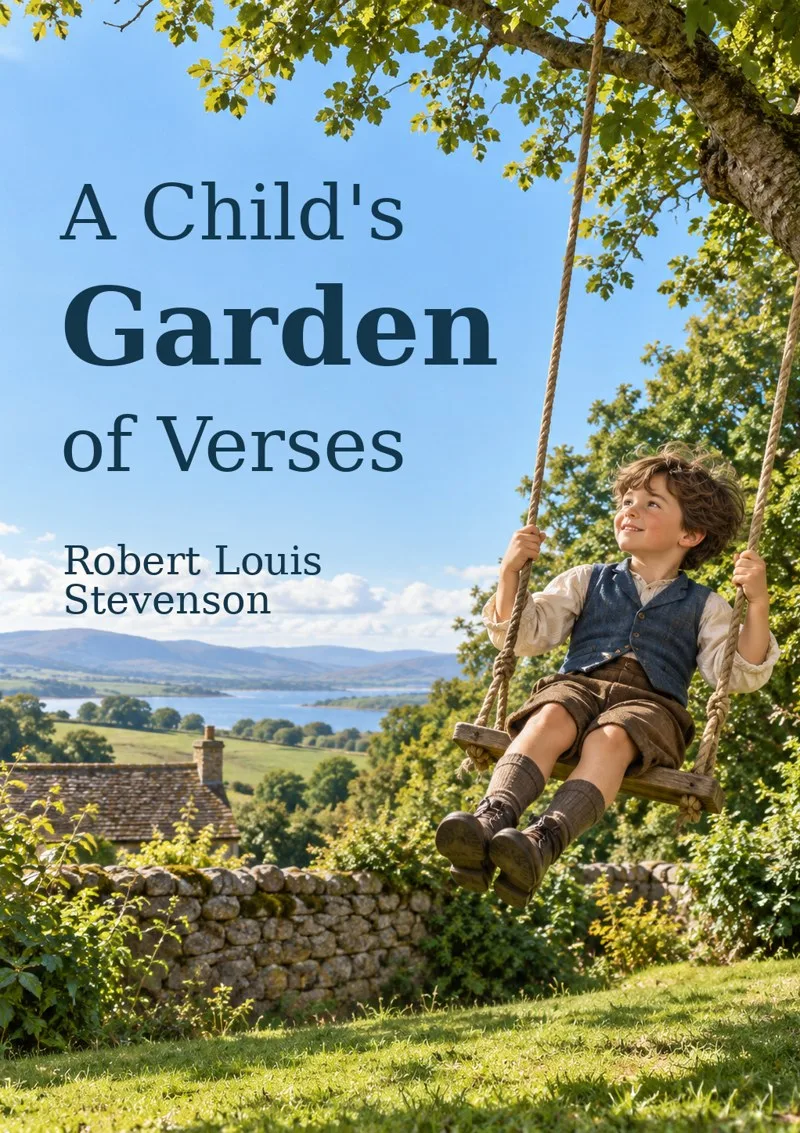
A Child's Garden of Verses at a glance
| author | Robert Louis Stevenson |
|---|---|
| first published | 1885 |
| genre | Children's poetry |
| length | 64 numbered poems, plus a dedicatory poem |
| english level | B1–B2 |
Beds, boats and the world beyond the wall
A Child's Garden of Verses is a collection of poems rather than a continuous story. First published in 1885, it moves through the things children notice: bedtime arriving before daylight ends, rain falling on different places, an unexplained shadow, a garden wall that limits the view. Each poem creates its own small occasion, often through a child's first-person voice.
Some experiences remain close to daily life. In Bed in Summer, the speaker objects to going to bed while birds and adults are still active outside. At the Sea-Side watches seawater enter holes dug in sand. Other poems let play reshape the surroundings. A meadow becomes a pirate's sea, while a sick child's bedspread becomes terrain for toy soldiers.
The opening sequence is followed by The Child Alone, Garden Days and Envoys. These groups shift the emphasis toward solitary invention, seasons and personal addresses to family or friends. A dedicatory poem thanks Alison Cunningham, Stevenson's childhood nurse. There is no central mystery to solve or plot to follow in order. The pleasure comes from entering one viewpoint, hearing its rhythm, then finding a different scale or mood in the next poem.
Listen to the swing and the passing train
The poems often make physical movement audible. The Swing alternates the rising view beyond a wall with the downward view of a garden and roof. Read aloud, its patterned returns help the reader feel the repeated arc. From a Railway Carriage works differently: successive glimpses of people, animals and buildings create the sensation of scenery disappearing before it can be examined. Comparing the two shows how rhythm can organise attention, not merely decorate a description.
Stevenson also makes ordinary objects do unexpected imaginative work. In Block City, the sofa supplies mountains and the carpet supplies a sea. The child does not need a magical entrance or an elaborate explanation; naming those objects differently creates a world. This is especially useful for a new poetry reader because the transformation remains visible and concrete.
My Shadow adds another kind of pleasure. The speaker treats an optical phenomenon as a companion whose changing size and morning absence need explaining. The child's confident reasoning lets an adult see more than the speaker sees, without making the poem depend on a difficult literary reference.
A collection to dip into and say aloud
Most poems offer a complete scene in a small space, so stopping after one or two does not break a narrative thread. Rain can be read as a brief exercise in noticing where the same weather falls; Travel expands into a much longer catalogue of imagined destinations. The collection therefore has varied proportions despite its many short pieces.
Reading aloud brings out differences that silent scanning can flatten. A marching rhythm, a swinging return and a bedtime cadence ask for different speeds. It helps to read a poem once for its scene and again for its sound, allowing line endings to remain audible.
The tone also changes. My Shadow invites amusement, while the dedication and personal addresses feel more reflective. Moral verses occasionally sound firmer than the playful pieces around them. A selection of favourite poems offers a different experience from reading the whole collection in its original sequence.
A child's voice, a nurse and the people nearby
There is no stable cast comparable to the characters in a novel. The recurring centre is a child speaker, but readers should not assume that every first-person poem describes one continuous day or one fully documented child. The voice may complain, invent, observe or proudly announce good behaviour.
Adults usually appear through their effect on that small world. A mother determines bedtime, a nurse supplies flower names and stories, and the gardener works according to routines the child finds frustrating. In The Lamplighter, Leerie's evening task becomes a profession the speaker longs to share. The adult's ordinary work looks remarkable from below.
The dedication gives Alison Cunningham a particular identity: she cared for Stevenson and read to him during childhood. Cousins, a mother and an aunt receive personal addresses in Envoys. These relationships broaden the collection beyond solitary play without turning it into a family narrative with conventional character development.
Small spaces with room for whole kingdoms
Imagination changes the size of the world. Foreign Lands begins with a child climbing a tree and seeing familiar surroundings from a new height; the view then encourages thoughts of places farther away. The Land of Counterpane reverses the direction. A child confined to bed becomes the observer of a miniature landscape made from bedding and toys. Freedom here depends partly on viewpoint rather than physical movement.
Solitude has more than one meaning. In The Child Alone, building, reading and pretending can make being alone productive. Yet an imagined playmate also suggests a desire for company. The collection leaves room for both pleasure and loneliness, instead of making solitary childhood uniformly happy.
Time enters through seasons, daily routines and the difference between adult work and children's play. Bed in Summer exposes the mismatch between a clock's command and the child's experience of light. The personal poems in Envoys introduce an older perspective on remembered rooms and gardens. That change in perspective gives the familiar play scenes an additional emotional weight, without requiring readers to treat each poem as autobiography.
Simple scenes, less simple poetic English
Common nouns such as bed, tree, rain and shadow make many scenes easy to picture. The difficulty appears when familiar words enter unusual comparisons, or an older word supplies the key to the scene. Counterpane means a bedspread: knowing that turns The Land of Counterpane from a puzzling place-name into a miniature landscape on a sick child's bed. Kirk in Block City names a church. Such words are worth checking because they clarify an entire image.
Sentences are often short, but rhyme can change word order, and a sentence may continue across several lines. Read to the punctuation rather than treating every line as a separate sentence. Repeated patterns help comprehension, especially in The Swing, while the accumulation of destinations in Travel asks for more attention.
Dialogue is limited. Much of the language is direct address or a child's monologue, so conversational fluency is less important than recognising who speaks and to whom. Victorian domestic habits, religious assumptions and older representations of distant peoples need context; some racial language is dated and derogatory.
B1–B2 is an editorial estimate for the original collection. Supported B1 readers can understand many individual scenes; B2 readers are better placed to follow unusual syntax and implied contrasts independently. The overall length is manageable in separate poems, but identifying an action is easier than hearing its rhythm or understanding its emotional perspective.
Readers who enjoy looking twice at ordinary things
Someone curious about English poetry can begin here without committing to a long narrative. My Shadow and At the Sea-Side provide concrete situations, while Block City rewards readers who remember constructing elaborate games from household objects. Adults interested in remembered childhood may respond more strongly to the dedication and Envoys than to the brief moral verses.
Shared reading suits the sound patterns, provided an adult explains unfamiliar words and historical attitudes when they arise. A child's interest in a swing or a toy boat can supply the starting point; a fixed age label is less useful than choosing the right poem.
Learners seeking modern dialogue or a continuous adventure may find the collection less suitable. Its strongest invitation is to pause over an image, then hear how the lines move.
Questions about A Child's Garden of Verses
Is A Child's Garden of Verses a story or a poetry collection?
A Child's Garden of Verses is a poetry collection, not a continuous story. Its 64 numbered poems create separate scenes of play, nature, bedtime and memory, with a dedicatory poem before them. Readers can choose individual pieces, though reading the groups in sequence reveals changes from immediate childhood impressions to more personal, reflective addresses.
Which poems are good starting points for an English learner?
My Shadow, Rain and At the Sea-Side are useful starting points in A Child's Garden of Verses because their situations are concrete and their length is modest. The Swing adds an easily pictured movement and repeated patterns. Reading aloud and checking one or two unfamiliar words can help before attempting longer pieces such as Travel.
Does the original collection contain old-fashioned language?
The original A Child's Garden of Verses contains older vocabulary, Victorian assumptions and some dated, derogatory racial language. A word such as counterpane can be explained briefly, while representations of distant peoples require historical discussion. The collection's simple scenes do not make every expression suitable as a model for present-day conversation.
References
Project Gutenberg — A Child's Garden of Verses, complete source text
The Robert Louis Stevenson Website — A Child’s Garden of Verses, 1885
The Morgan Library & Museum — A Child's Garden of Verses, 1885 edition