New Treasure Seekers; Or, The Bastable Children in Search of a Fortune — Adventures Built on Misunderstandings
KeepReap Editorial
A honeymoon in Rome sounds like an invitation to adventure, especially if nobody has actually invited you. That is the sort of reasoning the Bastable children bring to New Treasure Seekers. They turn a cookery book, an antiquarian society and a magazine editor into opportunities for action. Oswald tells their exploits with enormous confidence, while the details he supplies keep undermining his own account.
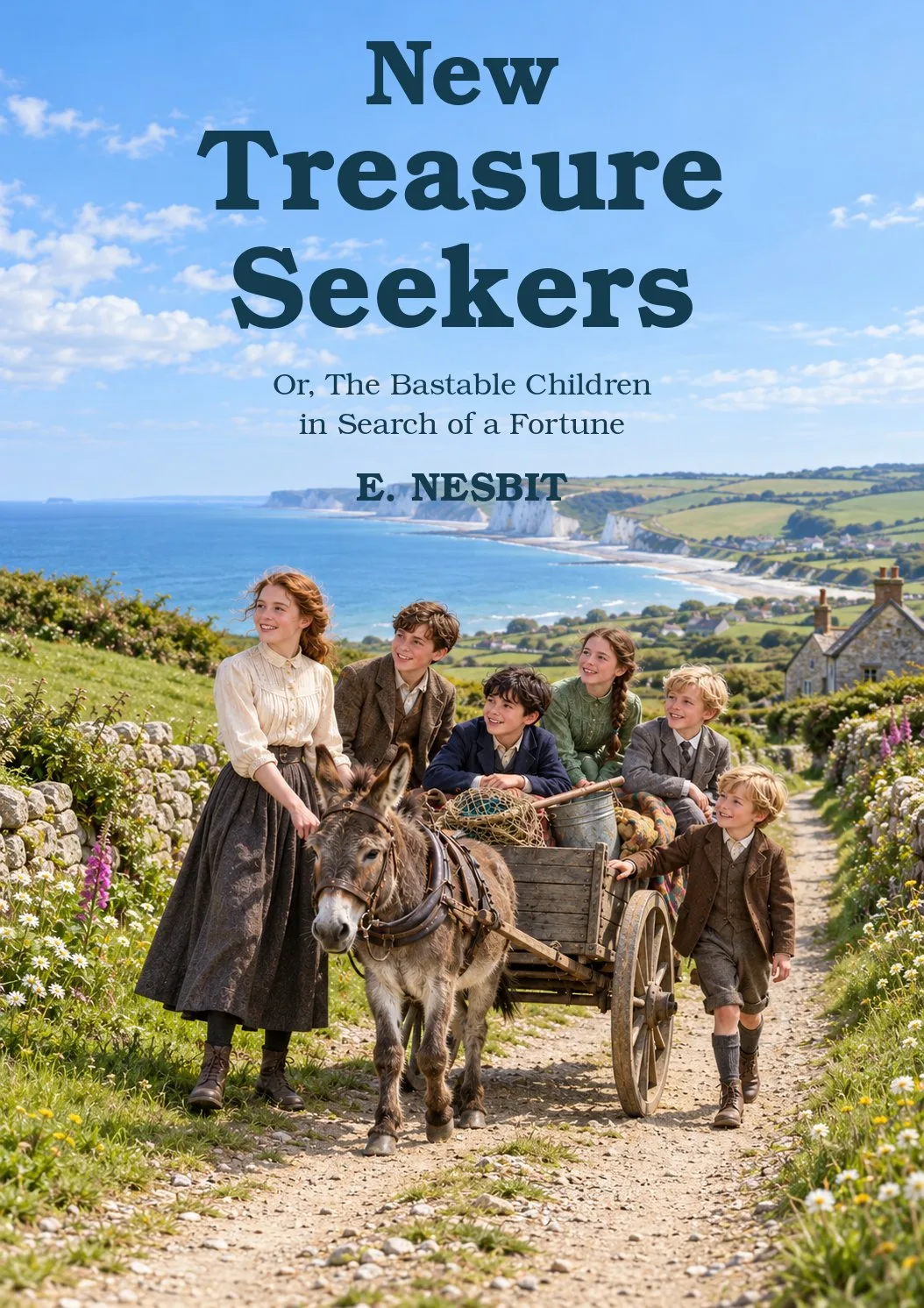
| Author | E. Nesbit |
|---|---|
| First published | 1904 |
| Genre | Comic family adventures |
| Length | 13 episodic chapters |
| English level | B2–C1 |
Rome, Christmas pudding and a seaside cottage
The Bastable siblings return with a supply of schemes that require surprisingly little encouragement. A relative’s wedding and honeymoon give the youngest brother, H.O., ideas about travelling to Rome. Elsewhere, the prospect of a disappointingly plain Christmas pudding prompts the children to investigate what a more ambitious celebration might involve. Ordinary announcements become starting points for enterprises the adults never intended.
The thirteen chapters move among family houses, London streets, an intriguing old house and the seaside. The children form their own antiquarian society, investigate unfamiliar spaces and decide that a magazine editor needs to hear their opinion of a story. Later, while staying at Miss Sandal’s cottage in Lymchurch, they make plans to help her financially. Taking lodgers, attempting trade and imagining themselves as smugglers or wandering performers all seem possible from their perspective.
These adventures belong to the familiar Bastable family world rather than a magical kingdom. Practical arrangements, money, permission and other people’s motives keep interrupting the children’s imagined versions of events. Oswald’s narration connects the episodes: he explains their intentions, protests their innocence and occasionally lets an awkward fact slip into the explanation. The interest lies in following the gap between an exciting plan and its encounter with everyday life.
An adventure starts before the facts are checked
The chapter titles promise the scale of an adventure serial: an intrepid explorer, a mysterious prophetess, a smuggler’s revenge. The material beneath them often begins with a room, a letter or a conversation. That mismatch establishes the rhythm. A mundane object acquires an adventurous meaning, the siblings agree just enough to proceed, and the world resists their interpretation.
Oswald repeatedly interrupts his account to correct a sibling, defend a decision or explain what a proper author ought to do. These digressions can slow the action but also supply much of its comedy. A reader who enjoys a brisk sequence of incidents will find plenty; a reader who skips every aside will miss why those incidents are funny. The quieter encounters matter too, particularly when someone outside the family cannot be fitted comfortably into their game.
Six siblings, several incompatible plans
Oswald controls the account and often claims the credit. He praises his own modesty, describes his noble intentions and refers to himself in the third person when it improves the effect. His siblings provide evidence that his preferred version is incomplete. Dicky shares practical schemes and can be inventive when revenge becomes tempting; Noël brings poetry and romantic visions that the others alternately encourage and ridicule.
Dora’s concern for manners and right conduct does not remove her from the action. Her secret sewing for H.O. places her inside the opening adventure before the others understand what is happening. Alice contributes judgement as well as enthusiasm, and Oswald’s admiration for her sometimes clashes with his assumptions about girls. H.O.’s eagerness gives the family reasons to worry about plans already under way.
Albert’s uncle is a writer whose professional troubles offer the children another supposed problem to solve. Miss Sandal’s habits, meanwhile, become evidence in their private theory about her circumstances.
Watch what happens when words become instructions
The book offers a particularly good way to notice how a comic story can grow out of language rather than accident alone. In the antiquarian episode, the children borrow the outward signs of learned authority: spectacles, papers and organised proceedings. Their solemn performance makes their understanding of scholarship visible. The comedy comes from watching them imitate a social role they only partly understand.
The magazine episode develops a different mismatch. The siblings admire Albert’s uncle’s sensational fiction and assume that their enthusiasm should settle an editor’s professional judgement. Their campaign brings private loyalty into contact with publishing work. What looks obvious within the family becomes less convincing outside it.
Nesbit also lets the narrator expose himself without an adult explanation after every joke. Oswald’s declarations of fairness sit beside exclusions, irritation and self-interest. Readers can recognise the discrepancy for themselves. That active reading position makes familiar adventures worth examining sentence by sentence, rather than treating each chapter simply as another amusing mishap.
Who needs help, and who decides?
Helping is repeatedly entangled with the pleasure of having an enterprise. The children believe Miss Sandal needs money and begin designing solutions around that belief. Their plans give them costumes, trade, travel and unusual encounters. A useful question is therefore whether they have understood the supposed beneficiary or merely found a convincing reason to pursue an appealing adventure.
Money is concrete throughout these stories. Ingredients, fares, parcels and licences create limits that imaginative plans do not abolish. The peddling episode makes the difference especially clear: declaring an honest purpose cannot supply the legal permission the children lack. Their good intentions remain real, but they do not automatically make an arrangement workable.
Oswald’s concern with honour also contains a struggle over appearances. Being seen as generous or brave can compete with doing something uncomfortable for another person. The quieter meeting with a lonely boy shifts the attention away from grand schemes toward the difficulty of ordinary consideration. The book allows affection for the children while asking readers to inspect the assumptions, social distinctions and self-congratulation within their accounts.
Easy actions, difficult implications
Many actions are easy to picture: sewing, mixing pudding, climbing a ladder or approaching a stranger. Dialogue often uses short exchanges, and repeated sibling disagreements help establish who wants what. Those features can make individual scenes accessible before a learner understands the narrator’s full effect.
Vocabulary raises the difficulty. Schoolboy expressions such as ripping, shortened words and mock-grand descriptions appear beside terms connected with domestic service, old currency and antiquarian learning. A modern dictionary may give a literal meaning without explaining the attitude. The licence episode also depends on the difference between the children’s everyday understanding of permission and a specific requirement for trading.
Sentence structure alternates between direct speech and long, branching explanations. Oswald adds qualifications, changes direction and addresses the reader, so tracking the main clause can require rereading. Noël’s poetry and the adults’ letters create further changes of register. Nonstandard speech needs attention without being treated as a model for formal writing.
B2–C1 is an editorial estimate for independent reading with attention to irony and historical context. A B2 reader may follow much of the action while missing jokes; fuller appreciation often requires C1 skills or explanatory support. The thirteen chapters allow stopping between episodes, but their cumulative length still demands stamina. Learning every unfamiliar word before moving on is less useful than checking which misunderstanding drives the current scene.
For readers who enjoy catching the narrator out
The strongest match is a reader who enjoys noticing that a storyteller’s explanation does not quite fit the evidence. The antiquarian performance and the intervention with the magazine editor reward that habit. Adults can enjoy the professional and social misunderstandings alongside the children’s immediate excitement; younger readers may respond first to the plans and sibling quarrels.
English learners comfortable with modern children’s fiction should still expect extra work here. Reading one episode at a time, identifying the children’s aim and then checking the adult situation gives a manageable route through Oswald’s digressions. Readers seeking sustained magic, a single treasure hunt or contemporary language may find the title misleading. Historical racial and cultural stereotypes also need discussion, especially in the China and fortune-telling episodes, rather than being silently adopted as accurate descriptions.
Questions about reading New Treasure Seekers
Is New Treasure Seekers one continuous treasure hunt?
No. New Treasure Seekers contains thirteen linked adventures involving the Bastable siblings, with Oswald’s narration supplying continuity. Some schemes concern money, but others involve exploration, scholarship or defending a writer. Following the children’s changing interpretations is more useful than looking for a single hidden treasure that all the chapters pursue.
Does New Treasure Seekers contain real magic?
New Treasure Seekers principally turns ordinary situations into imagined adventures. Its explorers, smugglers and fortune-telling performers are children taking on roles, rather than inhabitants of a magical world. The tension comes from the distance between those roles and practical reality, including household arrangements, adult motives and rules about trade.
Must an English learner understand every joke?
No, but noticing the central misunderstanding helps substantially. In New Treasure Seekers, a learner can often follow what the siblings physically do while missing why their explanation is unreliable. First identify what they believe, then compare it with the adult response. Return to unusual vocabulary and ironic asides after the action is clear.