The Story of the Treasure Seekers: Can You Trust Oswald?
KeepReap Editorial
Oswald insists that he is fair, brave and unusually sensible. The events he describes often suggest something else. That gap gives The Story of the Treasure Seekers its peculiar intimacy: you hear a child arranging the evidence in his own favour while learning how much he cares about his family. E. Nesbit’s six siblings seek money in ordinary London, armed with extraordinary expectations borrowed from books.
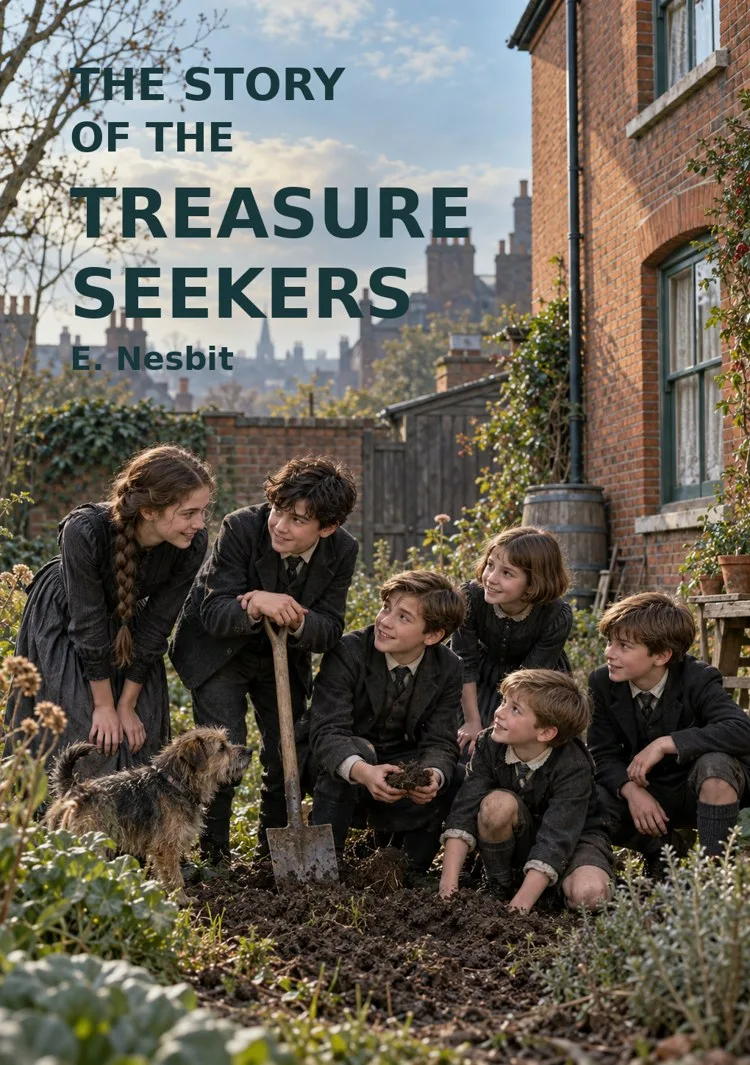
The Bastables’ adventure
| Author | E. Nesbit |
|---|---|
| First published | 1899 |
| Genre | Comic family adventure |
| Length | Approximately 52,000 words; 16 chapters |
| Original English | B2–C1 |
Six children make a financial plan
The Bastable children live in Lewisham Road with their widowed father. His business troubles have changed the household: familiar possessions disappear, repairs wait, and the children stop attending school. Dora, Oswald, Dicky, Alice, Noel and their youngest brother, H. O., recognise more of the difficulty than adults suppose. They decide to restore the family’s fortunes themselves.
Their first council produces a list of possibilities drawn from adventure stories, newspaper advertisements and their own inventions. Digging in the garden seems a reasonable beginning. Detecting criminals, selling poetry and finding a generous benefactor might prove more profitable. Each experiment creates a fresh collision between what a story promises and what an actual neighbour, editor or tradesman will tolerate.
A child narrator reports these attempts with confidence, frequent interruptions and a strong interest in deciding who deserves credit. The family’s financial anxiety gives the games purpose, but the book leaves plenty of room for quarrels, awkward conversations and domestic improvisation. Its movement is episodic: one scheme gives way to another, while relationships and misunderstandings accumulate. The question is less where a hidden fortune lies than how children can help when their understanding of money and adult life remains incomplete.
The evidence against Oswald’s own account
Read the opening council alongside Oswald’s account of his own peacemaking. He presents himself as the reasonable sibling, yet his method includes kicking Noel to hurry him along. Nesbit lets action contradict self-description without inserting an adult voice to explain the joke. Readers become judges of evidence rather than passive recipients of a moral.
A second mechanism is the mismatch between borrowed literary grandeur and ordinary objects. The children call their modest household an ancestral house; the nursery becomes a dungeon; a trip to a newspaper office becomes an expedition. The inflated language is funny because the settings remain stubbornly recognisable.
The scene with the editor adds another layer. Noel’s earnest poetry and the boys’ account of their purpose expose them to an adult response they cannot fully interpret. What the narrator considers obvious may be touching or amusing to someone older. Reading those two responses together gives the book emotional depth without requiring a solemn explanation after each adventure.
One scheme, one interruption, another scheme
A chapter usually begins with a new possibility and develops into an encounter that the children cannot entirely control. Between schemes, Oswald interrupts to defend a decision, dismiss a convention or explain what a proper book ought to include. His refusal to describe uneventful days in the second chapter is itself a miniature comic performance.
This creates a conversational pace rather than a continuous race towards a concealed object. The homemade newspaper briefly changes the texture: verses, advice and contributions interrupt ordinary narration, letting the siblings’ editorial ambitions appear on the page. Later domestic scenes can carry more anxiety than the jaunty voice initially admits. You may laugh at the confidence of an explanation and then recognise the worry beneath it. That change in distance is the book’s characteristic rhythm.
Who disagrees at the nursery council?
Dora, the eldest, repairs stockings and repeatedly asks whether a proposed enterprise is right. Her practical work complicates Oswald’s tendency to portray caution as dullness. He wants decisive action and admiration; Dicky wants details, calculations and workable plans. Their disagreements shape the council before any treasure hunting begins.
Alice combines imagination with direct sympathy. Noel, her twin, writes poems and approaches the idea of a princess with particular seriousness. H. O., short for Horace Octavius, is the youngest, and his literal questions puncture the older children’s performances. None of the six stays neatly inside a single role.
Their father’s worry gives the adventures a purpose he does not always see. Albert-next-door becomes an unwilling participant in some games, while his uncle understands their imaginative language better. These adults and neighbours matter because the children must encounter people whose patience, needs and interpretation of events differ from their own.
A family’s worry inside a game
Money is first understood through visible absences. Oswald notices missing silver, damaged carpets and the disappearance of treats before he can explain the business trouble behind them. Nesbit builds financial insecurity out of household observations rather than an abstract account of poverty. The children’s determination to help grows from affection and incomplete knowledge together.
Their reading supplies both resources and mistakes. A storybook rescue promises a grateful stranger and a reward; real life offers consent, inconvenience and consequences the script leaves out. The recurring experiment tests whether an exciting narrative can serve as a practical guide. Imagination makes the siblings energetic, but it does not automatically make them considerate.
The treatment of Albert sharpens that distinction. The children can explain their conduct in the language of fairness while ignoring how he experiences their game. Oswald’s defence of himself therefore becomes part of the ethical question. Beneath the quarrels, the loss of their mother remains present in mourning clothes, interrupted routines and the effort to protect their father from further sadness.
Following the action and hearing the second meaning
The actions are often concrete: children dig, argue, travel by train and knock on doors. Many exchanges use short sentences, so a learner can follow who wants what before catching every joke. The harder task is noticing when Oswald’s explanation disagrees with the behaviour he has just described. B2–C1 is an editorial estimate for the original, with B2 readers likely to need occasional support and stronger readers better placed to follow its irony independently.
Vocabulary mixes everyday domestic words with period slang and borrowed adventure language. Terms for old money, servants, clothing and newspaper work can slow a scene down. Oswald’s formal expressions sometimes parody the books he reads; treating them as ordinary conversation misses their purpose.
Sentence structure is uneven. Direct dialogue can be simple, but digressions add qualifications, parenthetical remarks and shifts between first-person narration and references to Oswald by name. Some speakers use dialect spellings, requiring readers to recognise spoken words behind unfamiliar written forms.
Historical context also matters: the railway journeys, household credit and childhood assumptions about class belong to late Victorian life. Roughly 52,000 words across sixteen chapters require stamina. A supported learner may understand individual adventures without understanding every cultural reference; completing the whole book independently asks for more than identifying its basic plot.
For readers willing to question a confident storyteller
Choose this book if you enjoy narrators whose confidence invites you to question them. The garden excavation and newspaper project offer concrete adventures, but Oswald’s self-justifications supply much of the pleasure. Readers expecting a map-led expedition or supernatural treasure may find the domestic setting surprising.
For shared reading, siblings’ competing accounts make useful stopping points: ask what happened before accepting who claims to be generous. Independent English learners should be willing to investigate selected money terms and let some allusions pass. The narrator also repeats prejudices and stereotypes from his period, particularly in descriptions of outsiders and imagined adventures. Younger readers benefit from discussion of those assumptions alongside the treatment of Albert. The humour rewards attention to other people’s feelings as well as to the narrator’s words.
Questions about the Bastables
Is The Story of the Treasure Seekers a fantasy novel?
The Story of the Treasure Seekers is principally a realistic comic adventure, although its children constantly interpret ordinary life through imaginative games. They invent princesses, bandits and heroic rescues without acquiring magical powers. A reader seeking Nesbit’s enchanted objects should expect a different experience here: the mismatch between make-believe and actual neighbours creates the adventures.
Why does the narrator talk about Oswald in the third person?
The narrator of The Story of the Treasure Seekers pretends to conceal which Bastable child is telling the story. Referring to Oswald by name helps sustain that performance while giving his supposed bravery and fairness special attention. The obvious partiality is part of the joke, so readers should compare his claims with the conduct he reports.
Can I read The Story of the Treasure Seekers one chapter at a time?
Yes, The Story of the Treasure Seekers works well in chapter-sized sessions because most chapters centre on a particular scheme or encounter. Keep track of the siblings, their shared financial purpose and the adults they meet, since those relationships continue across episodes. Pausing after each experiment can also make the narrator’s explanations easier to examine.