The Story of the Amulet: Time Travel and the Wish for Home
KeepReap Editorial
The children can step into ancient Egypt, but they cannot simply step into the family life they miss. That tension gives The Story of the Amulet its direction. Published in 1906, E. Nesbit's fantasy follows four siblings searching across time for the missing half of a red charm. Their travels expose unfamiliar societies, while an ancient visitor makes ordinary London look unfamiliar too.
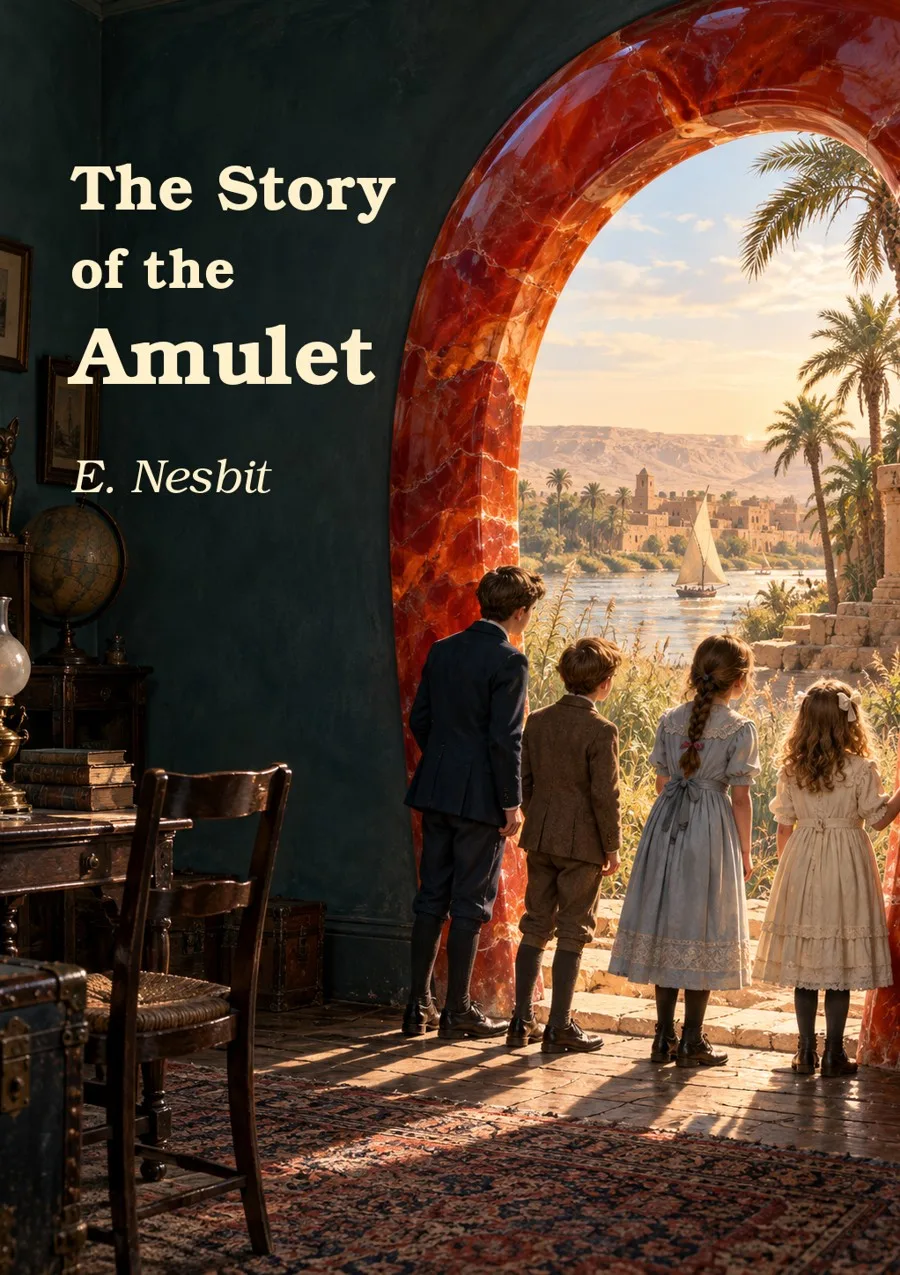
| Author | E. Nesbit |
|---|---|
| First publication | 1906 |
| Genre | Children's fantasy; time-travel adventure |
| Structure | 14 chapters |
| English level | B2–C1 |
Half a charm, centuries to search
Cyril, Robert, Anthea and Jane spend their holidays in London under the care of their old Nurse. Their father is abroad reporting on the war in Manchuria; their mother is recovering from illness in Madeira with their baby brother, the Lamb. A walk among small shops unexpectedly brings them back to the Psammead, the furry sand-fairy they already know.
The creature directs them toward an ancient charm. Once complete, it can grant their hearts' desire, but the piece they buy is only half of it. Its remaining power opens an arch through which they can enter other times. Finding the missing half becomes a search through Egyptian villages, Babylonian courts and further historical or legendary settings.
These journeys involve more than looking at monuments. The children must negotiate with strangers, judge danger and manage disagreements about what to do next. Their knowledge of modern life sometimes helps and sometimes produces alarming misunderstandings. Meanwhile, a scholar lodging upstairs can read an inscription that makes their extraordinary project possible.
The novel alternates departures with returns to Fitzroy Street. Each expedition broadens the search, but the children's original longing keeps its emotional purpose clear. The central question is whether traveling almost anywhere can help them recover the particular home they want.
Four siblings and a lonely scholar
Anthea often holds the group together through attention to other people's feelings. Her kindness to the upstairs scholar begins with his neglected meals, giving friendship a practical form before the grander adventures develop. She is also the child who offers a bracelet as a sign of peace during an early encounter in Egypt.
Cyril likes to organize and explain. His confidence can provide direction without guaranteeing sound judgment. Robert contributes energy, schemes and frank reactions to frightening situations. Jane's questions and impulses matter even when the older children dismiss them; her separate experience in Babylon changes what the others must do.
The Psammead knows ancient things, offers advice and dislikes discomfort. It is a companion with limitations and irritability rather than an endlessly available rescue service. The learned gentleman, whom the children call Jimmy, supplies scholarship but initially treats impossible experiences as dreams. His solitude makes the children's affection as significant as their fascination with his knowledge.
When a museum visitor claims the exhibits
The Babylonian queen's visit to the British Museum reverses the usual direction of a historical adventure. Instead of modern children gazing at ancient objects, an ancient person looks at the museum's possessions and insists that they belong to her. Displays that London treats as settled facts become the centre of an argument about ownership and authority.
That reversal gives the book a sharp comic method. Familiar places become strange when someone arrives with different assumptions about servants, wealth and power. The children have to interpret both sides while managing an adult whose royal certainty does not fit the city around her. You can follow the commotion without accepting either society as the natural standard.
A quieter attraction is Jimmy's relationship with Anthea. The same story that can summon a winged figure in a dungeon also makes room for a cold meal and a lonely man. These scales reinforce one another: the wish to cross centuries grows out of small, recognizable needs for care and companionship.
What should a better world give its children?
A wish for happiness sounds limitless until the children's circumstances give it a definite shape. They miss their parents and baby brother. The contrast between that intimate desire and the immense range of their travels keeps the magical object from becoming merely a device for collecting spectacular destinations.
The future episode asks a different question: what would an ordinary room look like if children's needs shaped society? Padded furniture and protection from burns become evidence of priorities. Anthea's questions about people without homes push the conversation beyond a comfortable household toward the distribution of security. Nesbit makes an imagined improvement concrete enough to compare with familiar arrangements.
The British Museum episode similarly unsettles confidence about possessions and civilization. A queen who seems absurd in London can nevertheless reveal assumptions that its residents rarely examine. Ancient rulers are not automatically wiser, either. Across these encounters, rank and learning can coexist with ignorance. Jimmy's expertise matters, but so does his willingness to listen to children and admit that experience exceeds his usual categories.
An adventure with one foot in Fitzroy Street
An expedition can begin with a practical discussion and end in genuine fear. The early Egyptian journey includes an exchange of gifts, then the threat of a village attack. Babylon brings hospitality alongside the possibility of imprisonment. That movement between curiosity and vulnerability gives the search more pressure than a procession of sightseeing stops.
Nesbit's narrator continually keeps the children close to the reader, commenting on their reasoning and comparing unfamiliar things with everyday objects. The interruptions can be funny, but they also mean that the pace is not continuously fast. A conversation may matter as much as an escape.
Repeated returns to the lodging house provide bearings. The arch makes enormous changes possible, while meals, rooms and the learned gentleman restore a recognizable scale. The chapters form connected excursions in one developing quest rather than independent tales to read in any order.
The language beyond the time-travel plot
The children's arguments are often easier to follow than the narrator's jokes about them. Requests, refusals and urgent instructions give many scenes a clear line of action. For independent reading, B2–C1 is an editorial estimate: B2 readers may follow the search with dictionary support, while C1 readers are better equipped for irony, allusions and shifts of register. These are different kinds of understanding, not an official rating.
Vocabulary ranges from household objects and period slang to amulets, priests, ancient places and ceremonial language. A recurring word for a room's furniture may deserve attention; an unfamiliar proper name can often remain a label. This distinction helps prevent every historical reference from stopping the story.
Sentence structure also changes with the speaker. Brief sibling exchanges sit beside longer explanations containing asides and comparisons. Track the main action before unpacking each interruption. Dialogue sometimes represents pronunciation through altered spelling. Imogen's speech, for example, needs to be heard as a voice rather than treated as a succession of unrelated dictionary words.
Historical context includes imperial attitudes and prejudicial caricatures, especially in the London episode. Recognizing these helps readers evaluate the narrator's perspective. Finally, fourteen substantial chapters demand sustained reading. Illustrations can orient a scene, but they cannot explain every joke or replace understanding the sentences.
Choosing this adventure as your next English novel
Choose this novel if you want historical fantasy in which negotiating with people matters as much as entering an extraordinary place. The Egyptian gift exchange, the queen's museum argument and Jimmy's astonishment offer different pleasures from a story organized around battles or a single villain.
Readers who enjoyed The Phoenix and the Carpet will recognize the siblings, but the search across time gives this book a more sustained objective. Its opening also supplies enough earlier history for a newcomer to begin here.
English learners should be comfortable leaving some proper names and minor allusions unresolved. B2 readers may benefit from notes and shorter sittings; C1 readers can attend more closely to the narrator's social comparisons. Shared reading gives younger readers space to discuss danger and dated prejudice. Someone seeking uniformly contemporary, simple English may find the historical dialogue tiring.
Questions about the amulet and its journeys
Must I read the earlier Psammead books before The Story of the Amulet?
No, The Story of the Amulet opens by explaining the children's earlier connection with the Psammead and the events that leave them in London. Reading Five Children and It and The Phoenix and the Carpet first adds continuity to the siblings' memories. The new charm, its missing half and the purpose of the search are introduced within this novel.
Is The Story of the Amulet an accurate guide to ancient history?
The Story of the Amulet is fantasy rather than a dependable history textbook. Nesbit gives its journeys material detail and dedicates the book to the British Museum's Wallis Budge, but magic and a legendary Atlantis belong to the same narrative. Treat the settings as imaginative encounters and check individual historical claims separately when using the book for study.
Can a B2 learner understand The Story of the Amulet?
A B2 learner can often follow The Story of the Amulet with help for historical vocabulary and dialect spellings. Understanding why the queen's London visit is satirical takes more contextual knowledge than tracking where the children go. The B2–C1 estimate distinguishes supported plot comprehension from more independent understanding of the narrator's irony and references.