The Magic City: A World Built from Toys, Books and Jealousy
KeepReap Editorial
What happens when a city made for your own amusement starts making demands of you? In The Magic City, a boy's arrangement of books, bowls and toys becomes a country he must learn to live in. E. Nesbit's 1910 fantasy ties that extraordinary change to an ordinary grievance: Philip fears that his sister's marriage has left less room for him.
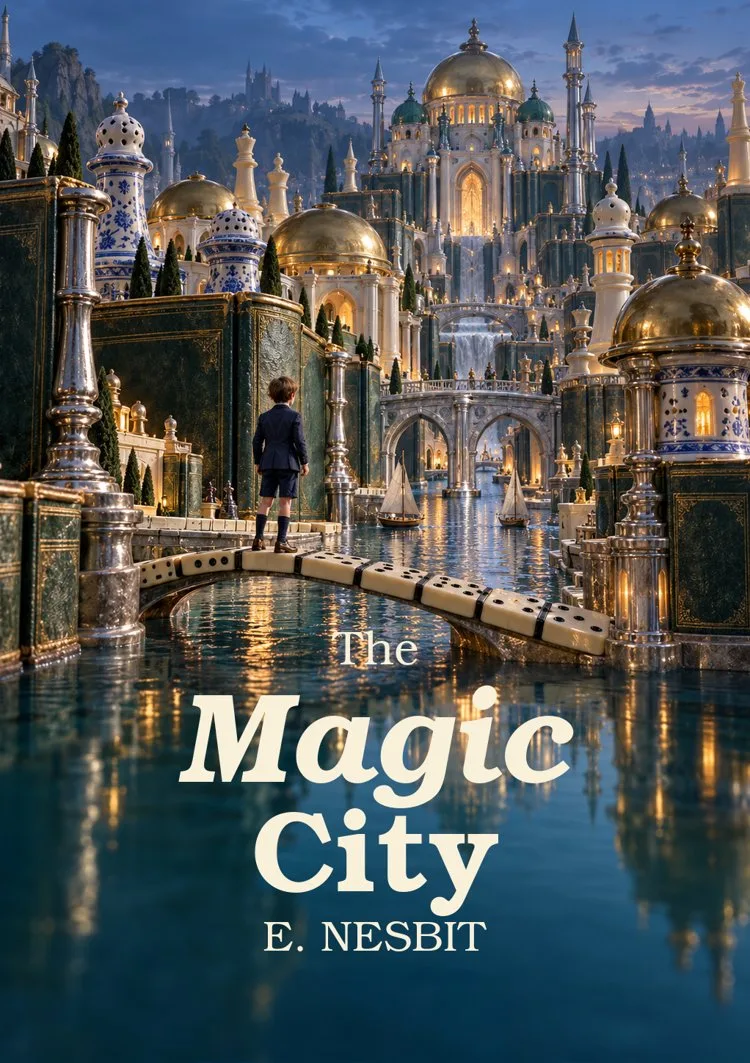
The model and the novel
| Author | E. Nesbit |
|---|---|
| First published | 1910 |
| Genre | Children’s fantasy; model-world adventure |
| Length | Approximately 59,000 words; 12 chapters |
| English level | B2–C1 |
A city whose materials never quite disappear
A brass finger-bowl becomes a dome; books become architectural supports; toy soldiers carry the small green bases on which they once stood. The pleasure lies in recognising what each magnificent object used to be. Nesbit keeps the materials visible inside the transformation, so the reader can move between a child's tabletop and an inhabited country without losing either perspective.
That double vision changes how problems work. A threatening creature may require knowledge of a toy rather than the strength expected of a conventional hero. The city therefore rewards practical observation. Readers who remember how the model was constructed can sometimes see possibilities before Philip does.
The other attraction is the collision between official grandeur and everyday sense. Mr. Noah administers an extraordinary society with solemn rules, titles and ceremonies, while children still need meals and sensible advice. The gap produces comedy without making the world's needs unreal. Its inhabitants can be funny and still deserve Philip's attention.
Philip builds somewhere to escape
Ten-year-old Philip Haldane has grown up with Helen, his much older half-sister, who has cared for him since their parents died. Their games and imagined island belong to a private world shared by two people. When Helen marries, Philip fears that he has lost his place in her life. Her husband's daughter Lucy becomes the easiest target for his resentment.
Left in an unfamiliar household while the newly married adults are away, he finds relief in building. Bricks alone cannot satisfy him: books, candlesticks, bowls and toys become a complex city across the drawing-room furniture. At night, a visit to admire his creation carries him into a place where those improvised structures have become enormous and their occupants are alive.
Lucy enters the adventure too. The city must decide whether Philip is its promised Deliverer or a destructive intruder. A sequence of difficult deeds gives the children a route through its strange institutions and surrounding country, but building a world proves easier than understanding everyone in it. The novel combines a quest with the less comfortable task of learning to cooperate with someone Philip has already decided to dislike.
The boy who builds and the girl who notices
Philip wants Helen's affection to remain exclusively his. His hostility towards Lucy begins before he knows her, which makes their eventual collaboration more interesting than an immediate friendship. He is inventive and capable of courage, yet his desire to look heroic can obstruct his judgement.
Lucy is a year younger and has her own knowledge of toys, games and practical work. When she identifies familiar objects in the city, she supplies an explanation Philip has missed. Her contribution to their tasks challenges his assumption that the adventure should belong to him alone.
Helen remains the emotional centre of Philip's life even when absent. Mr. Noah, recognisable from a toy ark, explains the city's rules and assigns deeds with ceremonious authority. Mr. Perrin the carpenter brings working knowledge to its puzzles. A rival claimant, the Pretenderette, complicates the children's position: the right to be called a Deliverer is contested, rather than simply granted to whoever built the model.
Can a maker keep everything for himself?
Creation does not cancel responsibility. Philip has assembled the city's materials, but its people have needs and expectations that are independent of his pleasure in making it. Once he meets them, the model can no longer be treated as something he may arrange solely to suit himself. The question becomes what a maker owes to a world that has acquired a life.
His relationship with Lucy repeats that question on a smaller scale. He wants to control the story of his new family before listening to its other member. The practical deeds repeatedly require him to consider knowledge and preferences that are not his own. Cooperation tests the limits of his claim to be the sole hero.
Helen and Philip's imagined island gives exclusiveness a physical form: an apparently perfect refuge can also keep other people outside. Elsewhere, the city's factories present useful work as an activity people can enjoy, contrasting with the disruption caused by the Great Sloth. The book links imagination to shared living through places, rules and labour, rather than leaving it as a private escape.
A quest interrupted by practical questions
Before the grand adventure begins, the narrator stays close to Philip's hurt feelings. Small domestic frustrations make his anger recognisable, even when his treatment of Lucy is unfair. The movement into the model city expands the scenery without replacing that emotional problem.
The deeds provide forward motion and changes of setting: monumental streets give way to open country and the sea. New puzzles invite the reader to inspect objects and rules, while conversations frequently interrupt the rush towards action. The narrator addresses the reader and comments on the conventions of adventure stories.
Expect an amused storytelling voice rather than constant peril. Official speeches can slow a scene deliberately, allowing their absurdity to become visible. Moments of fear remain important, but a practical detail or an inconvenient rule often alters what appeared to be a straightforward heroic challenge.
Reading the object beneath the enchantment
Recognising the ordinary object inside the fantasy is also a useful reading strategy. A finger-bowl, a pepper-pot and a candlestick are more than background vocabulary: their shapes explain the architecture. Learn such recurring object words early, then picture what they become. Otherwise a clear action may take place in a setting that remains confusing.
Sentence structure alternates between brief exchanges and longer explanations with qualifications or narrator's asides. In an extended passage about the city, finding the main action before resolving each interruption helps. The children's dialogue is usually more direct than Mr. Noah's formal announcements, while Mr. Perrin's nonstandard spellings require attention to the spoken sound.
Historical context includes Edwardian household arrangements, obsolete objects and the conventions of heroic quests. Classical references and grand official vocabulary create jokes that cannot always be recovered through a literal dictionary definition. Watch for a solemn expression applied to an obviously ordinary toy problem.
The original has roughly 59,000 words in twelve substantial chapters, so it asks for sustained reading. B2–C1 is an editorial estimate: B2 readers can often follow the main adventure with vocabulary support, while C1 readers are better placed to appreciate register shifts and irony independently. Pictures clarify the objects; they cannot supply every verbal joke.
For builders, puzzle-solvers and shared reading
Model builders and readers fascinated by the rules of invented worlds have a particularly clear way into this story. Recognising a household object beneath a palace, animal or machine becomes part of the adventure. Someone interested in family change may instead begin with Philip's fear of losing Helen and follow what that fear makes him do.
Shared reading works well when an adult can explain unfamiliar objects or pause over a pompous announcement. Independent learners should be comfortable with a full novel and occasional dialect spelling. Readers who prefer magic without lengthy explanations may find Mr. Noah's rules cumbersome; those who enjoy solving practical puzzles can make those same explanations part of the fun.
Questions about the model world
Is The Magic City a sequel to Five Children and It?
No, The Magic City is a separate novel with Philip and Lucy as its central children. It does not require knowledge of the Psammead or the siblings in Five Children and It. Its model-built world explains its own rules, although readers of other Nesbit fantasies may recognise her interest in the practical consequences of imagination.
Why are household objects important in The Magic City?
Household objects explain both the landscape and many of the puzzles in The Magic City. Buildings retain traces of the books, bowls and toys from which Philip constructed them. Recognising their original uses helps the reader understand the children's observations and the practical possibilities of a world whose enchantment does not erase its materials.
Can a B1 learner read the original The Magic City?
A B1 learner may follow selected episodes of The Magic City with substantial support, but independent reading of the complete original is considerably harder. Historical object names, dialect spelling and formal comic speeches create difficulties beyond the visible action. The B2–C1 editorial estimate reflects those demands; illustrations and explanations can help without making every joke immediately accessible.