Rebecca of Sunnybrook Farm: Summary and English Level
KeepReap Editorial
A coach carries Rebecca Randall from her family's Sunnybrook Farm to the home of her two aunts in Riverboro, Maine. That simple journey opens a novel about growing up under rules that do not always make room for imagination. Kate Douglas Wiggin follows Rebecca through village school, friendship, writing, and new opportunities. This guide explains the story without its ending and considers what an English learner will find accessible—and what may take patience.
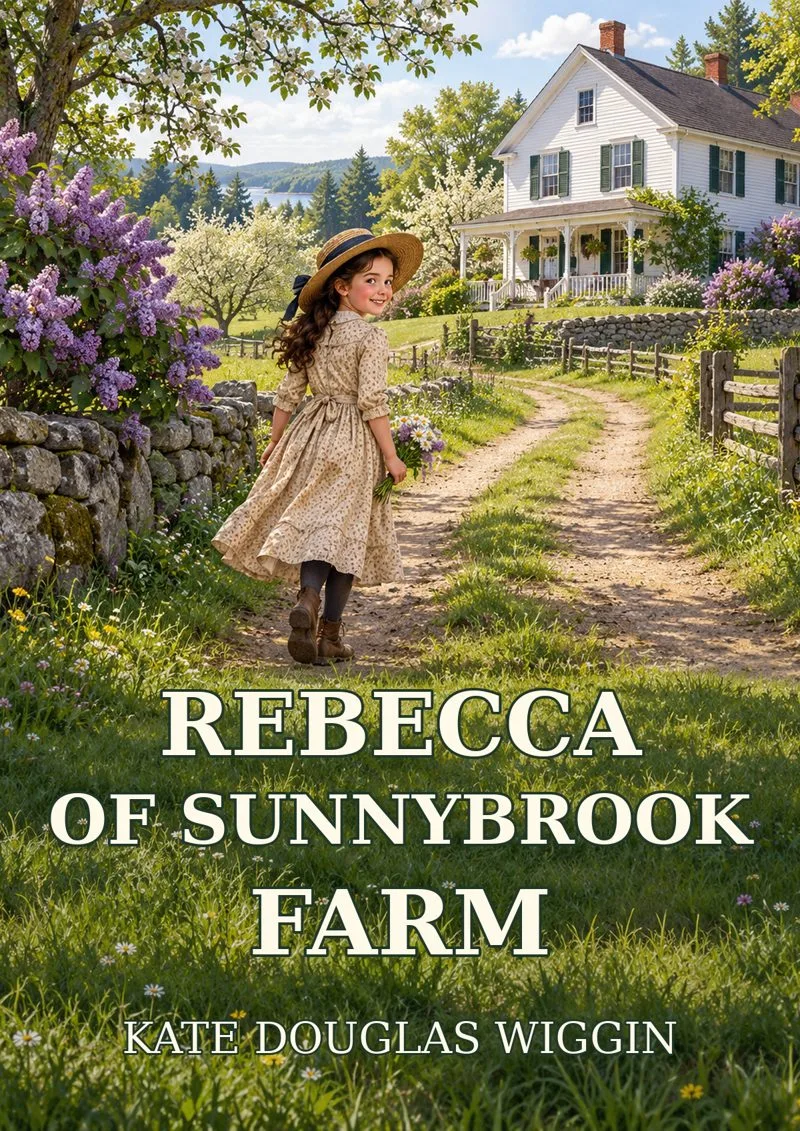
| Author | Kate Douglas Wiggin |
|---|---|
| First published | 1903 |
| Genre | Children’s coming-of-age novel |
| Length | Approximately 73,000 words in the Project Gutenberg text |
| English level | B1–B2 |
Spoiler-free summary
Rebecca Rowena Randall leaves a crowded household at Sunnybrook Farm to live with her mother's sisters in Riverboro. On the stagecoach she immediately draws the driver, Jerry Cobb, into conversation; her talk and bright attention to everything around her establish the energy she brings to the brick house. Aunt Miranda expects neatness, obedience, and practical results. Aunt Jane is gentler, but the two women share responsibility for a child whose explanations and inventions often outrun their patience.
Riverboro gives Rebecca a school, a close friend in Emma Jane Perkins, and a larger social world. She writes letters and poems, performs at school, gets into trouble over a new dress, and becomes involved with the Simpson children. One episode has Rebecca and Emma Jane selling soap to help obtain a lamp for the Simpsons; the effort leads to consequences neither girl has fully anticipated. The incidents are often funny, yet money, illness, and the work of caring for others remain present beneath the comedy.
As Rebecca grows older, her education widens beyond Riverboro. Wareham school offers teachers, writing, and a sense of possible futures that the younger Rebecca could barely have named. The novel follows her changing understanding of family duty and ambition without abandoning the lively voice that made her conspicuous on the first coach ride. Readers can expect linked episodes of home, school, friendship, and responsibility rather than a single adventure with a mystery to solve.
Why it is worth reading
Wiggin makes Rebecca's imagination visible through action rather than merely calling her imaginative. Her first letter home compresses impressions of the aunts, the coach driver, and her new surroundings into a child's eager, sometimes comic account. Later, her school recitations and experiments with poetry show how language becomes a way to test who she might be. The pleasure is in watching a thought turn into speech, then watching another character react to it.
The adults are more varied than a simple division between kind and unkind. Miranda's rules can be exasperating, while Jane's warmth gives Rebecca room to recover from mistakes. Jerry Cobb listens in a different register, and Miss Maxwell recognizes abilities that need serious teaching. Their responses make the same girl appear troublesome, entertaining, generous, or promising, depending on who is looking. That shifting perspective gives the domestic scenes their tension.
The soap-selling and banquet-lamp sequence is especially useful for seeing the book's balance. A child's hopeful plan enters a world where a lamp also needs oil and wicks. The result is humorous without treating the Simpson family's material needs as imaginary. Small practical details repeatedly test Rebecca's grand ideas, giving the story more texture than a series of cheerful school anecdotes.
Main characters
Rebecca Randall is talkative, observant, and eager to write; she can also misunderstand a situation when her enthusiasm gets ahead of her judgment. Her move from Sunnybrook Farm to Riverboro places that temperament under close scrutiny. Miranda Sawyer, the stricter aunt, values order and reputation and often meets Rebecca's explanations with suspicion. Jane Sawyer is more sympathetic and helps translate between them, though she cannot simply erase the household's rules.
Emma Jane Perkins is Rebecca's loyal school friend. Their different temperaments give their shared errands and later school days a comic rhythm: Rebecca proposes, imagines, and speaks; Emma Jane offers steadier companionship. Jerry Cobb, the stagecoach driver, is an early listener whose conversations connect Rebecca's arrival with later changes. Her mother Aurelia remains a significant part of Rebecca's life even while the aunts direct her schooling. Miss Maxwell, a Wareham teacher, takes her writing and education seriously. Adam Ladd also crosses Rebecca's path in the soap-selling episode and remains part of the widening circle of adults who notice her abilities.
Themes
The book returns to the question of what adults mean by a “good” child. Miranda often measures behavior by quietness, tidiness, and obedience. Rebecca is capable of care, but it frequently arrives in noisy or unconventional form: a letter full of observations, an ambitious school performance, or an elaborate plan to help someone else. Their disagreements ask readers to judge intention and effect separately.
Education is more than a change of school buildings. Rebecca's walk to the Riverboro school, her pleasure in recitation, and her later arrival at Wareham mark expanding opportunities. Her writing gives that growth a visible form. It also exposes a tension between the time needed to develop a talent and the family's need for practical help. The story never makes those pressures disappear simply because Rebecca has promise.
Generosity, too, is tested by particulars. The lamp intended for the Simpson children is a vivid object of hope, but its need for fuel and wicks complicates the gift. The scene suggests that care requires attention to how people actually live. Across home and school, Rebecca learns to see beyond her first idea, while other characters must learn to see beyond their first impression of her.
What it feels like to read
Rebecca of Sunnybrook Farm moves through episodes rather than racing toward one central crisis. A coach conversation, a letter, a school recital, or a visit to the Simpsons can occupy sustained attention. The pace allows Rebecca's verbal energy to drive a scene, while the transitions between school terms show her gradually growing older. Readers who enjoy the texture of village life will have more to notice than readers looking for constant suspense.
The tone blends affectionate comedy with embarrassment and strain. Rebecca's imaginative language can make a small errand feel momentous, but Miranda's rebukes can make the same event painful. Wiggin also lets practical details interrupt idealized moments: the banquet lamp is beautiful, yet someone must pay for its oil. The result is often warm without being uniformly light. Later school and family responsibilities give the earlier jokes a different weight, so the book rewards attention to changes in Rebecca's voice and in the adults' reactions.
How hard is the English?
An editorial estimate for the original English is B1–B2. A B1 reader with support can usually follow the main action: the coach ride, household disagreements, school events, and friendships are presented in recognizable scenes. Understanding every joke and shade of feeling is harder. At B2, readers are better equipped for the shifting tone and the long conversations in which characters imply more than they say.
The vocabulary includes ordinary domestic and school words alongside older terms for clothes, transport, household objects, religion, and social customs. Sentences in the narration can be long and layered, although many exchanges are short and lively. Dialogue is a separate challenge. Jerry Cobb and several Riverboro speakers use regional spellings, shortened words, and nonstandard grammar. Reading these aloud may reveal the intended rhythm; treating each spelling as a new dictionary word usually does not help.
The 1903 setting also matters. School recitations, Aid Society meetings, stage travel, and the economics of a kerosene lamp may require brief historical context. Literary allusions and Rebecca's playful, elevated phrases can be understood approximately without decoding every reference. Finally, roughly 73,000 words demand reading stamina. An illustrated edition, short daily sections, and occasional notes can help a B1 reader follow the plot; a reader seeking independent appreciation of dialect and irony will likely want stronger B2 skills.
Who should read it?
This novel suits readers who like character-led stories about school, family, and an observant young person's changing place in both. Rebecca's letters, recitations, and friendship with Emma Jane provide concrete scenes to discuss, making the book useful for an English learner who wants to compare written narration with lively dialogue. A reader interested in how a girl's education was imagined in an early twentieth-century American setting will also find much to examine.
For independent reading, B2 is the more comfortable target. A motivated B1 reader can use chapter illustrations, a dictionary for recurring period terms, and notes on regional speech. Someone seeking a fast plot, contemporary conversational English, or a short graded reader may find the episodic length and dialect less suitable. The emotional rewards come from watching repeated encounters change meaning over time, not from trying to race to the last chapter.
Frequently asked questions
Is Rebecca of Sunnybrook Farm difficult to read in the original English?
The main events of Rebecca of Sunnybrook Farm are fairly clear, but the original dialogue and historical vocabulary make complete understanding harder. This guide estimates B1–B2: a supported B1 reader can follow the plot, while B2 is more comfortable for dialect, irony, and longer narration. The roughly 73,000-word length also requires stamina.
Is Rebecca of Sunnybrook Farm only for children?
No. Rebecca of Sunnybrook Farm was written as a children's novel, but its conflicts over schooling, work, money, and the way adults judge a child can interest older readers. The soap-selling and banquet-lamp episode, for example, combines a young girl's hopeful plan with the practical costs of helping another family.
What is Rebecca of Sunnybrook Farm about without spoilers?
Rebecca of Sunnybrook Farm follows Rebecca Randall from her family home to the household of her aunts in Riverboro, Maine. She makes friends, attends school, writes, and encounters adults with sharply different expectations of her. The novel traces her growth through linked family and school episodes rather than a single quest or mystery.