Little Men: Life at Plumfield With Jo's Boys — Summary and English Level
KeepReap Editorial
Little Men: Life at Plumfield With Jo's Boys follows Jo Bhaer after the events of Little Women. At Plumfield, the school she runs with her husband, a new boy's arrival opens a sequence of lively, sometimes difficult episodes about children learning to live together. This guide explains the premise without spoiling the ending, examines Alcott's schoolroom storytelling, and estimates how demanding the original English may be for today's learner.
Little Men at a glance
| Author | Louisa May Alcott |
|---|---|
| First published | 1871 |
| Genre | Children's novel; domestic and school story |
| Length | 21 chapters |
| English level (editorial estimate) | B1–B2 |
Spoiler-free summary
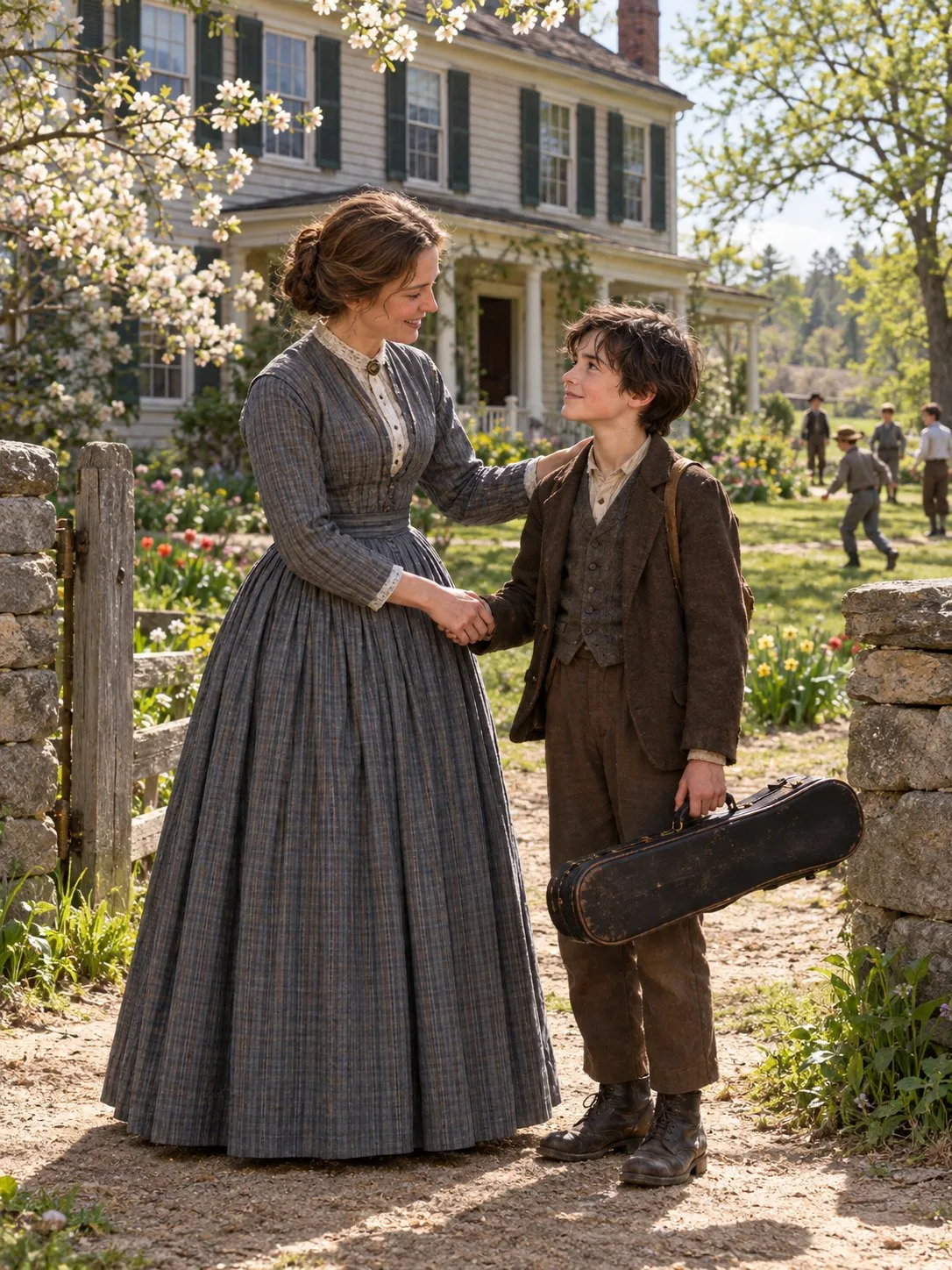
Little Men begins when Nat Blake, a poorly dressed and anxious orphan, arrives at Plumfield in the rain with a letter of introduction. He finds a large, noisy household rather than a severe boarding school. Jo Bhaer, formerly Jo March of Little Women, and her husband, Professor Bhaer, care for their own children and a group of pupils with distinct temperaments. Nat's violin, his uncertainty about belonging, and the welcome he receives provide an immediate way into the school.
The novel then moves among the children rather than following one uninterrupted quest. There are lessons and Sunday routines, games, gardens, pets, a little ball arranged by Daisy, summer berry picking, and an autumn harvest. New arrivals, especially the energetic Nan and the more troubled Dan, change the group's balance. Small disputes over property, truthfulness, pride, and loyalty can become serious to the children, and the adults must decide when to intervene.
Plumfield's lessons are often practical: children plant and sell crops, make things, perform music, and learn from the consequences of their choices. The pleasure of the book lies in watching these personalities rub against one another over a school year. It is a sequel with familiar adults, but Nat's arrival makes its setting understandable to a reader who has not recently read Little Women.
Why Little Men is worth reading
Alcott turns ordinary school incidents into tests of character without making every chapter a formal lesson. Nat's first view of the lit windows and busy rooms makes hospitality tangible before anyone explains Plumfield's ideals. Later, the children's gardens give work, ownership, rivalry, and cooperation visible form. A reader can see how a rule feels different to a boy earning money from eggs than to an adult imposing it.
The large cast also gives the narrative range. Daisy's carefully arranged ball and the boys' games are comic and affectionate, while Dan's restless energy asks more of Jo and Professor Bhaer than a simple reprimand. Alcott often lets one child misunderstand another, then uses conversation or shared work to reveal what was missed. The school's philosophy therefore emerges from recurring action rather than a single speech. Readers interested in Jo after Little Women will find her recognizable quickness and warmth, now tested by the daily responsibility of caring for many children.
Main characters
Jo Bhaer, formerly Jo March, is the adult center of Plumfield. She is imaginative and affectionate, but her care involves decisions about discipline as well as comfort. Professor Friedrich Bhaer shares the teaching and often responds to a child's mistake with patient attention. Their school is a household, so their own children, including Rob and little Teddy, live alongside the pupils.
Nat Blake is the newcomer whose hesitant entrance introduces the reader to the place; music gives him both pleasure and a way to contribute. Dan is an older, forceful boy whose resistance to rules requires a different kind of trust. Demi Brooke is thoughtful and fond of books, while his twin sister Daisy makes space for games and domestic projects. Nan's arrival gives Daisy an energetic companion and challenges the household's assumptions about what girls enjoy doing. Tommy Bangs adds schemes, jokes, and occasional trouble. The book repeatedly shifts attention among them, so no child remains its sole protagonist.
Themes at Plumfield
The central question is what kind of education helps a child grow. Plumfield has desks and lessons, but its gardens, workshops, walks, and games carry just as much weight. When the children raise potatoes or corn, effort becomes something they can measure, share, and sometimes quarrel over. Alcott links learning to the responsibility that follows an action.
Belonging is another recurring concern. Nat first sees comfort through the windows while wondering whether it can include him. Jo's welcome matters because it is followed by clothes, food, care, and a place among the other children. Dan's difficulties test whether the same household can make room for a child who does not respond easily to its customs.
The novel also questions narrow expectations for boys and girls. Daisy's ball and Nan's vigorous play do not produce identical roles; each girl enters the shared life of Plumfield in her own way. Friendship is similarly practical. Children defend, annoy, and forgive one another in the schoolroom, gardens, and willow tree rather than merely declaring themselves loyal.
What Little Men feels like to read
This is an episodic book. A chapter may begin with a small event—a girl wanting to join a game, a boy late with his composition, or a pile of harvested potatoes—and expand into a conversation about the whole household. The pace feels closer to spending a season with a family than racing toward one final confrontation.
Alcott's narrator sometimes addresses readers directly and moves briskly between humor and earnest moral reflection. Tommy's schemes and the children's performances give the school a comic noise; quieter scenes with Nat or Dan slow it down. The cast is large, so names and relationships may take time to settle. Readers who like the domestic rhythm of Little Women may enjoy seeing Jo in a new role, while those seeking a tightly plotted adventure may find the many short episodes less urgent.
How hard is the original English?
An editorial estimate for the original English is B1–B2, not an official CEFR rating. At B1, a learner can often follow the main action because chapters center on visible activities: a new child arrives, pupils play, someone gets into trouble, or crops are gathered. Short stretches of dialogue also help identify who wants what. Illustrations, audio, or occasional dictionary checks can make the broad story more accessible below B2.
Independent understanding of the language is harder. Alcott uses nineteenth-century household and school vocabulary, informal expressions such as boys' teasing nicknames, and words for clothing, tools, food, and customs that may be unfamiliar now. Some sentences carry several clauses and a narrator's aside before reaching the point. Conversation can imply disappointment or affection without stating it directly, and the narrator's playful irony may be missed even when the events are clear. References to religious practice and period expectations about discipline or gender add context that a modern learner may need to look up.
The 21 chapters are a stamina challenge as well as a language challenge. A useful approach is to read one episode at a time, keep a short list of recurring names, and check only the vocabulary that blocks understanding. Following Nat's welcome is easier than catching every joke or historical shade of meaning.
Who should read Little Men?
Little Men suits readers who enjoy ensemble stories about school, family life, and children learning through work and play. Someone who wants to continue Jo March's story will see her managing Plumfield, though the children rather than Jo alone occupy much of the page. It can also work as an original English classic for a patient B1 reader with support, or for a B2 reader who wants to notice the narrator's humor and period language.
A reader who prefers a single hero and a fast continuous plot may be frustrated by the shifts from Nat to Dan, Daisy, Nan, Tommy, and others. Younger readers may enjoy the games and school scenes with an adult to explain older expressions or social assumptions. The book rewards reading chapter by chapter rather than rushing through the whole cast.
Frequently asked questions
What is Little Men: Life at Plumfield With Jo's Boys about?
Little Men is about the children at Plumfield, the school and home run by Jo and Professor Bhaer. Nat Blake's arrival introduces its welcoming but busy household. Across school lessons, games, gardening, music, and disputes, the children learn how their choices affect one another. The novel follows the group through episodes rather than one continuous adventure.
Do I need to read Little Women before Little Men?
No. Little Men explains Plumfield through Nat, a newcomer, so its school life can be followed on its own. Reading Little Women first adds meaning to Jo March's later role as Jo Bhaer and to familiar family relationships. The children's stories still have their own setting and conflicts, making the sequel approachable without a recent reread.
Is Little Men difficult to read in the original English?
The main events of Little Men are often clear to an intermediate learner, but the original language is best treated as roughly B1–B2. Period vocabulary, long clauses, nicknames, and understated jokes can require support. A B1 reader may follow the story with illustrations or a dictionary, while a B2 reader is better placed to catch the narrator's tone independently.
How many chapters does Little Men have?
The Project Gutenberg text of Little Men: Life at Plumfield With Jo's Boys used here has 21 chapters. They move among Plumfield's children and activities, from Nat's arrival through lessons, games, summer outings, and seasonal work. Reading one chapter at a time helps keep the large group of pupils and their changing friendships clear.